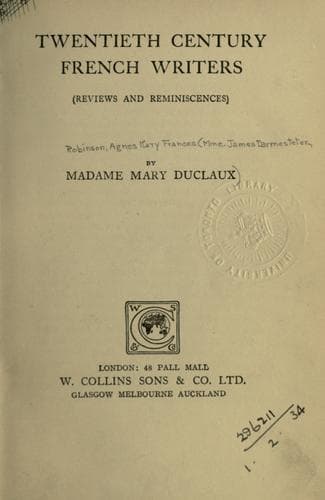
Twentieth Century French Writers: Reviews and ReminiscencesRobinson, A. Mary F. (Agnes Mary Frances)
History
Twentieth Century French Writers: Reviews and Reminiscences
Robinson, A. Mary F. (Agnes Mary Frances)
French literature -- 20th century -- History and criticism
But seek not there for the keen, anxious psychology of Philippe,
nor for the large poetry of Madame Audoux; nothing could be more
matter-of-fact, more _terre-à-terre_ (as we say in France), than _La
Vie d’un Simple_ or _Rose et sa Parisienne_. For that very reason these
books, and others from the same pen, are valuable to the inquirer who
desires to know, without any alloy of poetry, the real conditions of
the farmer’s and field-labourer’s life in France; but they are not
admirable to the artist like the novels of Jules Renard or Marguerite
Audoux. Obstinate, precise, Guillaumin delves his style as a peasant
tills his land--not (like Philippe or Madame Audoux, who are equally
fastidious and minute) in order to produce a certain effect of beauty
or impression of sensibility, but in the effort to render a just, exact
account of what he has seen.
His best book is _La Vie d’un Simple_. Regarded as art it is dull,
monotonous, and bare; and yet, considered as life, it is singularly
touching and ample, like one of those vast plains of France, traversed
by interminable, poplar-bordered roads, whose great sweeping lines
melt, far off, into long, low horizons.
_La Vie d’un Simple_ is the life of a peasant from the time when, a
child of seven years old, he pastures his sheep among the stubble
and the heather until, an old, bent man, too feeble to work on the
land, he again minds the herds at pasture, as they use in France.
Tiennou has lived all his life in front of the same horizon; he has no
book-learning; he knows nothing but the land; but he knows it well.
Like his father before him, he has been a _métayer_, that is to say,
a tenant-farmer who combines with the landlord to stock a farm, tills
it, and manages the live-stock, and pays his rent on a system of
half-profits.
The system is very common in France, and in theory is admirable. It
appears a means of uniting capital and labour in the cultivation of the
soil. But, if the tenant has no capital behind him, in bad seasons he
has to borrow at usurious interest. And then, if the cart-horse break
his neck, or the cow die of anthrax, on the top of a bad harvest, his
plight is poor indeed; for the landlord has a right to exact that stock
and tools shall always correspond to the inventory drawn up when the
tenant entered into possession. And too often, if he improves his farm,
the owner makes that an occasion for increasing his own pretensions.
Such is the fate of Tiennou, who, having spent the better part of his
life on bettering his land, in the end receives notice to quit.
Public-domain text, read in full here on John Shaqi.
Reviews
Reviews
No reviews yet
Be the first to share your thoughts on this work.
Elsewhere in the archive
Join the Discussion
Join the discussion
Sign in to leave a comment or review.
Sign InorCreate an account