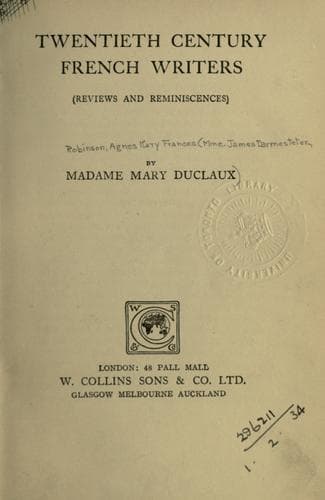
Twentieth Century French Writers: Reviews and ReminiscencesRobinson, A. Mary F. (Agnes Mary Frances)
History
Twentieth Century French Writers: Reviews and Reminiscences
Robinson, A. Mary F. (Agnes Mary Frances)
French literature -- 20th century -- History and criticism
Unless he be (as he so often is) a peasant-proprietor, the lot of the
French husbandman is austere. In a little pamphlet, _En Bourbonnais_,
M. Guillaumin has added up the yearly receipts of a day-labourer in
good work, turn by turn haymaker, harvester, thresher, wood-cutter,
and so on. His annual earnings amount, in English coin, to £21 12_s._
Though he be fed abundantly at the farms where he works all summer
long, still his family must live; and he must feed himself all
winter-time. And bread is dear in France; out of his twenty guineas a
year, the day-labourer must reckon fifteen or sixteen for bread alone.
The rent of the cottage will cost another £4; and there remains about
30_s._ for school expenses, shoes, clothing, fuel, doctoring, wine,
tobacco--all the pleasures and luxuries of life. No doubt he sells his
pig, and his kids and his poultry, and anything he can, to increase his
slender revenues; for, in the valley of the Allier, the peasant is too
poor to put a fowl in his pot on Sundays, or enjoy a rasher of his own
bacon by his own fireside.
Farther south, among the hills and high valleys of the Cantal, another
peasant-farmer, Antonin Dusserre, offers us, in his _Jean et Louise_,
another image of pastoral France: the rich yeomanry, the _Couarrous_
and _Couarros_, who compose the notable society of those isolated
villages, where the château is empty four-fifths of the year or more.
The _Couarros_ (rich grazing-farmers, intelligent, tenacious, positive,
active, and money-loving) compose a rustic middle-class far wealthier
than their simple lives would lead us to suppose, proud of their flocks
and herds, and their balance at the bankers. M. Dusserre, I believe, is
blind; but before that misfortune fell upon him, he has looked long and
lovingly at the high-lying heather, the cliffs capped with basalt, the
gentian-starred mountain-pastures, and the green glens and _trobers_ of
his native land. The landscapes and the types of the Cantal live on in
his inner eye.
Much farther west, on the borders of Anjou and Vendée, a village
schoolmaster, M. Pérochon, has recently given us a picture of
peasant life in the style of Guillaumin and Dusserre, in _Les
Creux-de-Maisons_. A _creux-de-maison_ is not, as one might expect,
one of those cave-dwellings hewn out of the chalky banks of the Indre
or the Loire, which look so primitive but which are said to be dry and
cosy, possessing the local reputation of keeping off rheumatism; no, a
_creux-de-maison_ is a sort of cabin about seven feet high, built of
mud or of rough stone cemented with clay, single-roomed, thatch-roofed,
with a pane for a window and an earthen floor.
Public-domain text, read in full here on John Shaqi.
Reviews
Reviews
No reviews yet
Be the first to share your thoughts on this work.
Elsewhere in the archive
Join the Discussion
Join the discussion
Sign in to leave a comment or review.
Sign InorCreate an account