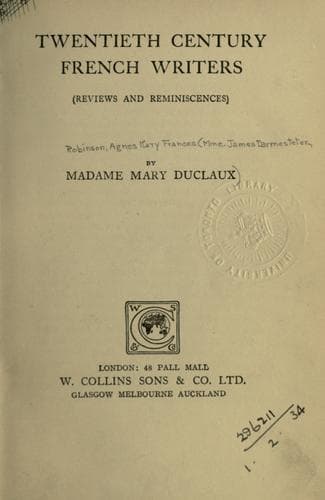
Twentieth Century French Writers: Reviews and ReminiscencesRobinson, A. Mary F. (Agnes Mary Frances)
History
Twentieth Century French Writers: Reviews and Reminiscences
Robinson, A. Mary F. (Agnes Mary Frances)
French literature -- 20th century -- History and criticism
‘C’était une cabane bossue et lépreuse, à peine plus haute qu’un
homme; on descendait à l’intérieur par deux marches de granit; il
y faisait très sombre, car le jour n’entrait que par une lucarne
à deux petits carreaux; l’hiver il y avait de l’eau partout, et
cela faisait de la boue qui ne finissait de sécher, sous les lits
surtout; il y avait des trous qui empêchaient les tabourets de
tenir debout; on les bouchait de temps en temps avec de la terre
apportée du jardin.’
Such are the _creux-de-maisons_, still not infrequent round Bressuire
in Vendée, though happily rarer every year, as the spread of creameries
and co-operatives brings the sense and the means of comfort into the
Ireland of France. M. Pérochon is perhaps a little unfair in taking no
notice of this clearing of the horizon: he will not allow us a gleam
of consolation; Zola himself was never more resolutely lugubrious. His
book is conceived in a low tone, a minor key, by a deliberate purpose,
and we must accept the artist’s postulate.
His theme is the life of a day-labourer from the day he leaves the
regiment till the time when, at forty-eight years of age, having buried
wife and child, he owns that life has been too much for him. He has had
his romance, has married the miller’s lovely daughter, and has seen
her die of want in the horrible _creux-de-maison_. He has watched the
children grow thinner month by month.
‘Depuis le Mardi-Gras, mes pauvres petits n’ont mangé ni lard, ni
œufs, ni lait ... quatre livres de beurre en tout depuis quatre
mois.... Je suis fatiguée de n’avoir rien à faire manger aux
petits; des haricots et des pommes de terre, des pommes de terre et
des haricots! Pas moyen seulement d’élever des poules!’
And indeed in the poorer parts of frugal France, so royally fertile,
there are many districts where the married labourer in winter used to
have little more in his larder; where a sack of potatoes, a sack of
chestnuts, and a sack of buckwheat supplied the chief of his diet, or
at least of his children’s diet if he be fed at the farm. I speak in
the past tense, but I fear it is so to-day in many a village of Lozère
or Brittany, where the food of the agricultural poor is as much worse
than it is in England, as it is better and more varied in Normandy or
Anjou or Touraine. And this constant strife between hunger and love,
between natures naturally tender, gay, and brave, and circumstances
continually depressing--has resulted in a stampede towards the towns,
a rural exodus, which is the great problem of the day in the poorer
provinces of France.
The war has singularly respected the writers of Pastoral novels. It
has even added to their ranks a new name, that of M. Henri Bachelin,
whose village tales, _Le Serviteur_, in 1918, _Le Village_, in 1919,
are direct and living sketches of rural France in the minute and
finely-stippled taste of Émile Guillaumin.
Public-domain text, read in full here on John Shaqi.
Reviews
Reviews
No reviews yet
Be the first to share your thoughts on this work.
Elsewhere in the archive
Join the Discussion
Join the discussion
Sign in to leave a comment or review.
Sign InorCreate an account