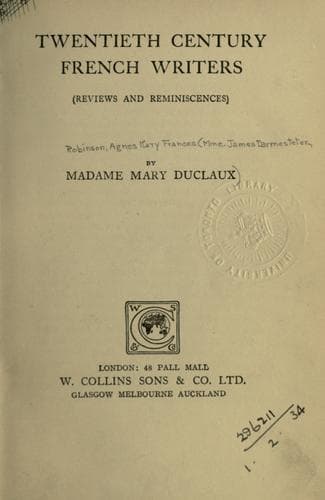
Twentieth Century French Writers: Reviews and ReminiscencesRobinson, A. Mary F. (Agnes Mary Frances)
History
Twentieth Century French Writers: Reviews and Reminiscences
Robinson, A. Mary F. (Agnes Mary Frances)
French literature -- 20th century -- History and criticism
M. René Boylesve was the first: _L’Enfant à la Balustrade_ appeared,
if I remember right, in 1903. We have considered in another chapter
the provincial studies of this exquisite author; here I will only
draw attention to his childish hero. Riquet Nadaud, the narrator of
_La Becquée_ and _L’Enfant à la Balustrade_,[3] is a little boy who
has been sent, on the death of his mother, to live with his maternal
grandparents in their old-fashioned house in the country near La
Haye-Descartes. How charming his descriptions of the child’s walks in
the fields with brusque and capable Tante Félicie I have had occasion
to declare elsewhere. For the moment my concern is with little Nadaud
when, after his father’s re-marriage, he goes back to live with his
parents at Loches.
The stepmother is a gentle, languid, gracious creature, born in America
though French by race, a beautiful Creole from Louisiana. Needless to
say, she is bored to death at Loches--not quite at first, when her
young loveliness, her position as bride, her gift for music, ensure
her a certain social importance and consideration. But her husband,
the notary, cribbed and confined in his narrow house--mindful, too,
that his first wife’s death had been in some degree attributed to that
house’s sunlessness--secures the reversion of the handsomest building
in the town, after the actual owner’s death. Unfortunately, M. Nadaud
was not the only man who had set his heart on that comely residence!
Soon the town is up in arms against the lawyer for stealing his march
on others, and poor Tantine, the foreign wife, is left alone in her
dull parlour with Riquet for her sole society.
Riquet--and young Dr Troufleau, faithful to his friends. Excellent
Troufleau, awkwardest, honestest of men! Charming Tantine, without
an evil thought in her feather-head! Alas, opportunity, thy guilt is
great! Out of sheer boredom on her part and simple pity on his, they
are drawn quite close to the edge of the abyss--close enough to feel
its attraction, its dizzy, strange, reluctant fascination--under the
sensitive eyes of the child who knows nothing of passion or of sin.
Doubtless that innocent presence it is that saves them; they recoil in
time.
M. Nadaud at last realises that his wife is being enervated by
solitude, demoralised by idleness, deprived of energy to resist the
simplest temptations. She needs social intercourse. A few visitors, a
little appreciation of her music and her beauty, and Troufleau would
soon occupy his proper place in her regard--that of a kind, friendly
young man, smothered in an absurd frock-coat and honestly in love with
another woman.
So the husband puts his pride in his pocket, and reconciles himself
with his neighbours; and things soon right themselves. Only a child has
apprehended that which does not belong to the world of a child, only a
boy’s lofty pure-minded ideal has been injured by contact with the hard
realities of life.
Public-domain text, read in full here on John Shaqi.
Reviews
Reviews
No reviews yet
Be the first to share your thoughts on this work.
Elsewhere in the archive
Join the Discussion
Join the discussion
Sign in to leave a comment or review.
Sign InorCreate an account