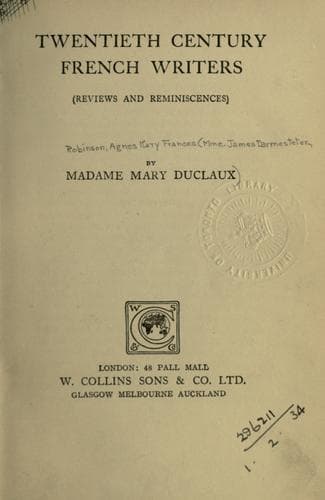
Twentieth Century French Writers: Reviews and ReminiscencesRobinson, A. Mary F. (Agnes Mary Frances)
History
Twentieth Century French Writers: Reviews and Reminiscences
Robinson, A. Mary F. (Agnes Mary Frances)
French literature -- 20th century -- History and criticism
Madame Tinayre, in a volume of stories, _L’Amour Pleure_ (1908),
took up the tale a few years later. Robert Marie is a lad of fifteen,
sixteen, seventeen, regarded as a ward by the notary of Beaugency and
his wife, Uncle Bon and Aunt Belle. He has no relations, only his
godfather and godmother, M. and Mme Cheverny, who live in Paris, and
who from time to time come down to see him. Robert can remember a
time, long distant, when there was no uncle Bon, no Aunt Belle, but,
so far back as his mind can carry, there have always been a M. and Mme
Cheverny, and always they have come to see him together.
He knows there is a mystery about his real parents; and the different
suppositions he makes concerning them, the gradual growth of his desire
to know who he really is, are the substance of this haunting story;
but not for a moment does he suppose that M. and Mme Cheverny (who
seem the sole links between him, poor waif, and those other boys who
have a place in the world, parents, a name) are not really M. and Mme
Cheverny, are not married: they whom he has not ever seen apart!--are
each of them married to another. And he is their son, brought up by
stealth, visited in mystery. The contrast between the passion of
these unhappy, charming parents and the robust indignant innocence of
their unconscious son is told with a sincerity and a romantic realism
peculiar, I think, to the work of Madame Tinayre.
About the same time--a year later, I think--in 1909, a young writer
from Marseilles, M. Edmond Jaloux, published his _Le Reste est
Silence_, which obtained the Prix Vie Heureuse for that year. There
are many points of contact between this novel and _L’Enfant à la
Balustrade_; but M. Jaloux has not the more than feminine delicacy,
the subtle moral tenderness of M. Boylesve. He, too, tells the story
of a small boy, the surprised, half-unconscious involuntary witness of
the growth of an unlawful love. Madame Meisserel is a less innocent,
less charming Tantine, and here, too, there is a dull, awkward, not
unpathetic husband.
The delicate sky, the gracious landscape of Touraine are replaced by
the busy brilliance of Marseilles; the key is higher, the sonority is
louder; and it is well that this is so; we need a dose of southern
brutality--or at least callousness--to enable us to digest the
supposition that it is the son of Madame Meisserel (now grown up)
who revives in reminiscence the history of his dead mother’s guilty
passion, as he witnessed it in his seventh year. How wise was M.
Boylesve to make his little boy a stepson, and the charming stepmother
almost innocent--a little frivolous at worst. We suspect Madame
Meisserel of having gone to greater lengths and yet we scarce forgive
her son his tone of superiority.
Public-domain text, read in full here on John Shaqi.
Reviews
Reviews
No reviews yet
Be the first to share your thoughts on this work.
Elsewhere in the archive
Join the Discussion
Join the discussion
Sign in to leave a comment or review.
Sign InorCreate an account