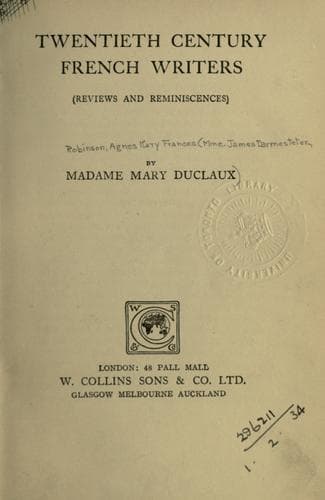
Twentieth Century French Writers: Reviews and ReminiscencesRobinson, A. Mary F. (Agnes Mary Frances)
History
Twentieth Century French Writers: Reviews and Reminiscences
Robinson, A. Mary F. (Agnes Mary Frances)
French literature -- 20th century -- History and criticism
No chapter in my book has a more delightful choice of reading than is
offered by these Novels of Childhood. And among the most enchanting
of all I would place _Le Grand Meaulnes_. Henri Alain-Fournier leapt
into being (from a literary point of view) in 1913 with this strange
romantic little novel. The book is not of our time in the least, though
without any affectation of archaism. It appears related far more nearly
to George Sand’s _Petite Fadette_, or to some tale of Musset’s, or to
Gérard de Nerval’s _Sylvie_, than to any Twentieth Century production;
and I think the closest we can get to it in our own times would be one
of the more poetical of Hardy’s Wessex novels, before he fell into
the tragic pessimism of _Tess_ or _Jude_. The poetry, the fantasy,
is all in the author’s imagination; for what, I ask you, could be
less romantic than the setting of his tale--a Training College for
Primary Education, or rather a large village Board-School, with a
class reserved for future teachers,--even though it be situate in the
very heart of Berry? And yet over every page of _Le Grand Meaulnes_
there slips and trembles the light that never was on sea or land.
The heroes are two lads of fifteen and seventeen; and rarely has any
author rendered more delicately the prestige of the big boy for the
little boy, and the chivalrous half-mystic hero-worship in which he
walks enveloped. The mystery, the beauty, the wonderfulness of the
poet’s world transfigure the homely story, which is merely that of a
schoolboy of fifteen who runs away from school, who misses his way and
gets caught up in the whirl of a large country wedding at a quaint
half-ruined manor-house whose name he does not know. Never again can
the lad find that manor or that beautiful girl who was the bridegroom’s
sister, with whom he has fallen in love. And at last his boy friend,
‘le grand Meaulnes’ discovers her, but keeps her for himself; the
capricious, fascinating Meaulnes marries that fairy Princess and
deserts her on the morrow, leaving her for all companionship and
consolation the adoring devotion of the humble friend, who tells the
story.
Those first rays of fame, which are brighter than the rising sun,
slipped over the young author’s fresh horizon. And then the war broke
out. Henri Alain-Fournier set out for Lorraine, a Lieutenant in the
Reserve; on September 22, 1914, he was reported missing. For many
months, for nearly a year, the hope that dazzles so many tearful
eyes--the hope that he was retained by the Germans a prisoner in
the invaded provinces, from which no communication was allowed with
France--sustained his family and friends and that portion of the public
who, like myself, watched his career with sympathy. And then, one day
last summer, I heard the sad story.
Public-domain text, read in full here on John Shaqi.
Reviews
Reviews
No reviews yet
Be the first to share your thoughts on this work.
Elsewhere in the archive
Join the Discussion
Join the discussion
Sign in to leave a comment or review.
Sign InorCreate an account