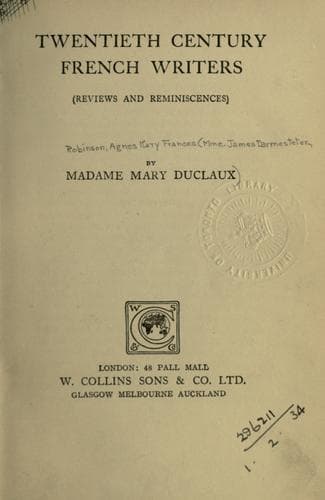
Twentieth Century French Writers: Reviews and ReminiscencesRobinson, A. Mary F. (Agnes Mary Frances)
History
Twentieth Century French Writers: Reviews and Reminiscences
Robinson, A. Mary F. (Agnes Mary Frances)
French literature -- 20th century -- History and criticism
The same theme, in 1912, furnished M. Gilbert des Voisins with the
matter of _L’Enfant qui prit Peur_. Here the plot is pushed to a
tragedy; the child, aghast to find the serpent rampant in his little
Eden, and his father’s friend his mother’s lover, commits suicide. We
are still further here from M. Boylesve’s exquisite moral delicacy.
We neighbour it again in _L’Élève Gilles_, the first novel of a young
schoolmaster which, in 1912, obtained the new great prize of the
French Academy--the prize of £400, as yet only twice bestowed: once on
_Jean-Christophe_ and once on the too-slender but charming book before
us. (I mention all these prizes to show the undoubted popularity of the
theme, and may add that M. des Voisins’ book very nearly obtained a
Prix Vie Heureuse.)
Gilles is a little boy suddenly sent from home to live with an old aunt
in the country because his father is suffering from neurasthenia and
needs a complete rest: no noise, no movement about him. The child’s
mother takes him and leaves him with her aunt and the old servant,
Segonde, whose portrait is one of the charms of the volume; and though
the lad is happy enough with them, we feel there is something poignant
behind--something we do not know, and that the child does not even
suspect. He is sent to the grammar school of the little town near
his aunt’s property, and we feel that the shadow--the unsuspected
shadow--hangs over him, there, too, increasingly evident to those about
him, though still invisible to the child narrator.
Little by little, by a word here, a silence there, by the sensitive
temperament of the child himself, by the strangeness of the father (who
has come for rest and change to the quiet country house) we learn the
truth: the man is mad. Gilles never knows it; but if he is so quiet, so
sensitive, and so solitary, it is because the whole little world around
him marks him for the madman’s child; a being to be spared, respected,
but not played with like another boy. He is a child apart.
Public-domain text, read in full here on John Shaqi.
Reviews
Reviews
No reviews yet
Be the first to share your thoughts on this work.
Elsewhere in the archive
Join the Discussion
Join the discussion
Sign in to leave a comment or review.
Sign InorCreate an account