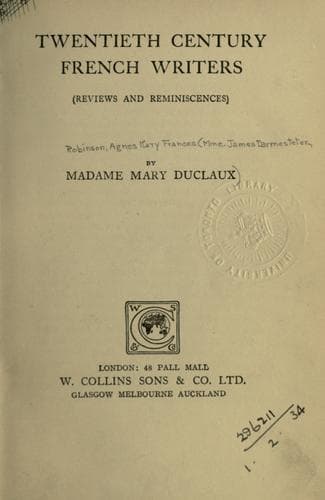
Twentieth Century French Writers: Reviews and ReminiscencesRobinson, A. Mary F. (Agnes Mary Frances)
History
Twentieth Century French Writers: Reviews and Reminiscences
Robinson, A. Mary F. (Agnes Mary Frances)
French literature -- 20th century -- History and criticism
Of all these books--save, perhaps, Alain-Fournier’s, for which I have,
I own, a peculiar weakness; of all these novels of childhood--unless
I except M. Boylesve’s, and _Marie-Claire_, and _Jean-Christophe_
(for so many of them, when you come to think of it, are really quite
first-rate)--the most delicate, the most pregnant with a sensibility
extraordinarily rich, and ample, and yet sensitive as the impressions
of convalescence or the first images of childhood, is an immense
novel, published in the winter of 1913-14 by M. Marcel Proust, under
the enigmatic title, _À la Recherche du Temps Perdu_: _Du Côté de chez
Swann_. The book with which it is easiest to compare it, is Henry
James’s _A Small Boy_, though that, indeed, is concise and simple
compared with M. Marcel Proust’s attempt at reconstituting the
vague shimmering impressions of a young mind, the wonderment with
which--inexplicably to us--it regards places and people which in our
eyes possess no magic. M. Proust’s hero is a small boy living in
the bosom of the most regular of families--one of those vast French
families, closely knit, whose tissue unites grandparents, great-aunts,
uncles, cousins in such quantity as to limit the possible supply of
outside acquaintance. One most familiar friend, however, there is,
the friend of the family, a ‘hereditary friend,’ as Homer would say,
M. Swann. He is a man of the world, a member of the Jockey Club, a
friend of the Prince of Wales, a comrade of the Comte de Paris, a
great collector; but for the small boy and his family he is especially
‘le fils Swann,’ the son of their old friend the member of the Stock
Exchange (‘qui a bien dû lui laisser quatre ou cinq millions’) who has
made a ridiculous marriage with a demi-mondaine--a case of all for love
and the world well lost.
And the world is lost the more completely that the impossible lady
continues her adventures unabashed and unabated after matrimony. She
therefore is not ‘received,’ or indeed hardly mentioned, in the ample
respectable home of the small boy; so that Swann and this unlikely
love of Swann’s, this beautiful wife of Swann’s, and Swann’s remote,
intangible, but not invisible little girl, are the constant objects of
his romantic curiosity.
Public-domain text, read in full here on John Shaqi.
Reviews
Reviews
No reviews yet
Be the first to share your thoughts on this work.
Elsewhere in the archive
Join the Discussion
Join the discussion
Sign in to leave a comment or review.
Sign InorCreate an account