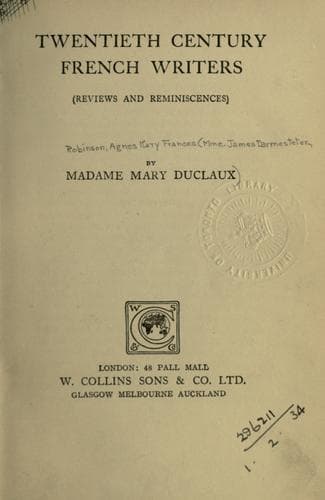
Twentieth Century French Writers: Reviews and ReminiscencesRobinson, A. Mary F. (Agnes Mary Frances)
History
Twentieth Century French Writers: Reviews and Reminiscences
Robinson, A. Mary F. (Agnes Mary Frances)
French literature -- 20th century -- History and criticism
There are two walks at Combray: you may set out in the direction of
Guermantes or else go round by Swann’s: ‘du côté de chez Swann,’ and
to the childish hero of the book these two walks gradually accumulate
round them the material for two views of life--Swann standing for all
that is brilliant, irregular, attractive, Guermantes representing an
orderly and glorious tradition. This long novel, _À la Recherche du
Temps Perdu_, sets out to recover, in three volumes, a child’s first
impressions in both sorts; but this instalment records (in 500 closely
printed pages) the earliest images _du côté de chez Swann_: images
forgotten by the intellect, mysteriously resuscitated by the senses--by
a tune sung in the street, or a whiff of thyme or mignonette, or (as
in the case of our author) by the flavour of a fragment of sponge-cake
dipped in tea; images in which matter and memory are subtly combined in
a sudden warm flood of life, revived, without the intervention of the
understanding.
In all this the influence of Bergson is evident. But can we imagine
the Twentieth Century in France without Bergson? As well conceive
the Eighteenth Century without Rousseau. Such a delicate excess of
sensibility does not exist without disorder; such a need to fuse and
unite the very depth of the soul with the ambient world--such a sense
of the fluid, pregnant, moving flood of life--exceeds the strict
limits of a perfect art. Evidently M. Proust’s novel, by its faults
as well as by its qualities, is admirably adequate to the spirit of
our age. Again, I repeat that, while I read with delight the delicate,
long-winded masters of our times, I think sometimes with regret of
a Turgeneff, no less subtle, who, even as they, wrote at tremendous
length and recorded the minutest shades of feeling, but, having
finished, went through his manuscript again, pen in hand, and reduced
it to about one-third of its original length.
In the case of M. Proust’s novel, the result is the more bewildering
that the book is conceived, as it were, on two planes; no sooner have
we accustomed ourselves to the sun-pierced mist of early reminiscence
than the light changes; we find ourselves in glaring noon; the
recollection becomes a recital; the magic glory fades from M. Swann and
the fair, frail Odette de Crécy; we see them in their habit as they
lived and moved among their acquaintance; we smile at the evocation of
an artistic coterie under President Grévy, and suffer a sort of gnawing
under our ribs as we realise the poignant jealousy of the unhappy
Swann. And then the light shifts again; we are back in childhood; and
Swann is again the mysterious idol of a dreamy, chivalrous little boy:--
Public-domain text, read in full here on John Shaqi.
Reviews
Reviews
No reviews yet
Be the first to share your thoughts on this work.
Elsewhere in the archive
Join the Discussion
Join the discussion
Sign in to leave a comment or review.
Sign InorCreate an account