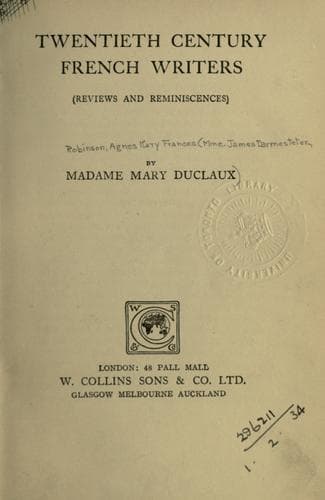
Twentieth Century French Writers: Reviews and ReminiscencesRobinson, A. Mary F. (Agnes Mary Frances)
History
Twentieth Century French Writers: Reviews and Reminiscences
Robinson, A. Mary F. (Agnes Mary Frances)
French literature -- 20th century -- History and criticism
‘Il me semblait un être si extraordinaire que je trouvais
merveilleux que des personnes que je fréquentais le connussent
aussi et que dans les hasards d’une journée quelconque on peut-être
amené à le rencontrer. Et une fois ma mère, en train de nous
raconter comme chaque soir, à diner, les courses qu’elle avait
faites dans l’après-midi, rien qu’en disant: “À ce propos, devinez
qui j’ai rencontré aux Trois Quartiers, au rayon des parapluies:
Swann,” fit éclore au milieu de son récit, fort aride pour moi, une
fleur mystérieuse. Quelle mélancolique volupté d’apprendre que cet
après-midi-là, profilant dans la foule sa forme surnaturelle, Swann
avait été acheter un parapluie.’
Can I end better than with this brief and casual quotation, which,
better than my criticism, will show the fresh and fine reality which
these pages mysteriously recover from the back of our consciousness
(where it exists in a warm penumbra of its own) and exhale, as
naturally as vapour from a new-ploughed autumn furrow? Something older
and deeper than knowledge pervades the book.
FOOTNOTES:
[3] Translated into English under the title of _The House on the
Hill_. David Watt, 1904.
EPILOGUE
As we glance from across the Channel at these writers, so often
consciously opposed, the charm of distance blends the tints, harmonises
the outlines, and shows us in most of them a certain similarity.
They are children of Dionysos, not of Apollo; they are mystics, not
materialists; they conceive existence as a great religious symphony
which you must experience and not seek to understand. More than once,
in reading the most liberal and modern among them, the words of the
Catholic, Claudel, have risen to my lips:--
‘Il ne faut pas comprendre; il faut perdre connaissance!’
They have, most of them, the intuition of a state transcending
reality--I mean objective reality. Yet, notwithstanding this
spiritual ideal, they set a high value on action, on social energy.
I have just said that, as a rule the French writers of the Twentieth
Century are mystics, but they are not ecstatics wrapt in a solitary
trance; they are eager to act on men and women, to bind them in
associations--though, of course, their groups are different, for
some of them are Socialists, like our pastoral novelists; many are
Nationalists from points of view as different as Rostand and Boylesve
and Barrès; and to some the only vital bond is a religion (since they
are French, naturally the Roman Catholic religion).
Public-domain text, read in full here on John Shaqi.
Reviews
Reviews
No reviews yet
Be the first to share your thoughts on this work.
Elsewhere in the archive
Join the Discussion
Join the discussion
Sign in to leave a comment or review.
Sign InorCreate an account