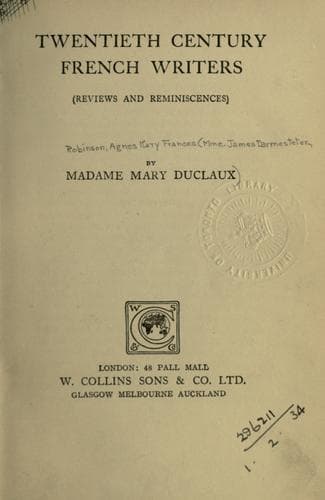
Twentieth Century French Writers: Reviews and ReminiscencesRobinson, A. Mary F. (Agnes Mary Frances)
History
Twentieth Century French Writers: Reviews and Reminiscences
Robinson, A. Mary F. (Agnes Mary Frances)
French literature -- 20th century -- History and criticism
Here he has written the tragedy of a free soul, the tragedy rather,
let us say, of a whole generation perpetually in quest of Truth and
Liberty. There are many stars in the sky; there are many virtues in the
soul of man; perhaps no two succeeding generations make their idols
of the same. Truth, Justice, Freedom, inflamed our youth with a noble
passion. The young men of to-day adore Courage, Activity, Self-control,
and Faith. They are optimists. We were pessimists. And Romain Rolland
writes, as a foreword to the tenth volume of his novel:--
‘I have written the tragedy of a generation which soon must
disappear. I have sought to dissimulate nothing of its vices or its
virtues--neither its heavy sadness, its chaotic pride, its heroic
efforts, nor its spent weariness under the crushing burden of a
superhuman task: for we had to renew our whole epitome of life,
our conception of the world, our æsthetics and our ethics, our
religion, our humanity.’
A Hamlet-like generation, intensely intellectual, sensitive, and
chivalrous, issuing painfully from the shed sheath of a worn-out
creed and struggling painfully towards a loftier faith and a
fuller life--such is the subject of _Jean-Christophe_. And the
author, merely middle-aged, has lived to see a new race inherit the
earth: a race ingenuous, ingenious, active, alert, little given to
self-questioning, or to any form of subtlety, and as a rule content
with the religion of its forefathers, just because it was the religion
of one’s forefather’s, and is probably as good as any other. Already
_Jean-Christophe_ is a portrait of the past, and certain volumes--as a
rule those we admired the most on their appearance: for instance _La
Foire sur la Place_--present the half-pathetic interest of a photograph
album ten years old.
What is still fresh, what is still moving and touching and delightful
is the story of a heart, the painting of passion and especially
the drawing of the feminine figures--the very numerous feminine
figures--who diversify the existence of Jean-Christophe.
The novel has been translated into English. My readers know (or at
least can easily learn) that the story is that of a great German
musician. It follows him from his childhood in a little Rhenish town,
to Paris, whither Jean-Christophe resorts, when, after a skirmish
with a Prussian officer, he has to flee for his life across the
frontier. There is no plot. The story is as ill-defined, as vague,
as fluctuating, as constantly developing, as life itself; and these
ten volumes are a sequence of episodes rather than a tale. Above all,
they are a criticism of contemporary Europe, or rather of the Europe
of yesterday, a Europe less infected with Nationalism, Imperialism,
Panslavism, than the instable and agitated compound that we know.
Public-domain text, read in full here on John Shaqi.
Reviews
Reviews
No reviews yet
Be the first to share your thoughts on this work.
Join the Discussion
Join the discussion
Sign in to leave a comment or review.
Sign InorCreate an account