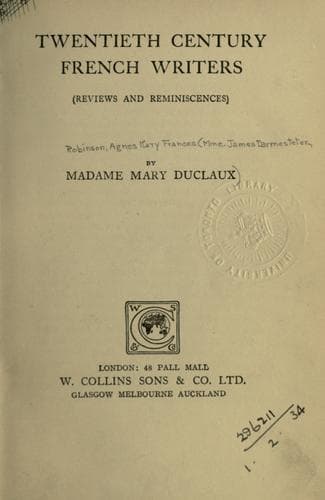
Twentieth Century French Writers: Reviews and ReminiscencesRobinson, A. Mary F. (Agnes Mary Frances)
History
Twentieth Century French Writers: Reviews and Reminiscences
Robinson, A. Mary F. (Agnes Mary Frances)
French literature -- 20th century -- History and criticism
In our case, So-and-so is Barrès. He has become all that we thought
he might become. Public life and the patriotic duty have absorbed him
more and more; he has been to the France of 1914-19 something of that
which Lamartine was in 1848. He, more than any, has preached the need
of union--‘L’Union sacrée,’ bringing into public affairs a largeness
of outlook and sweetness of temper rare in politics,--especially in
France. Few of these eloquent pages which day by day he has contributed
to the _Echo de Paris_ will remain as works of literature, but, piled
up, no longer read, in their accumulation they form a pedestal which
certainly heightens the moral importance of the man. Here at least we
have the satisfaction of finding our analysis exact. More and more, in
these days of storm and stress, Barrès has ‘felt the need of merging
himself in something larger and more durable than any individual
existence’; ‘no longer the singular, the extraordinary attracts him;’
he finds something pleasant and satisfying in the alliance of courage
and the spirit of adventure, ‘with a certain soldierly mediocrity of
mind’--and all the more when their conjunction ‘promises the conquest
of Alsace-Lorraine.’ Above all, he has given himself heart and soul
to ‘the creation of a truly National Party, capable of bringing out
of chaos a new organic order.’ Shall we not say of him that, like his
heroine, Colette, ‘Il se sent chargé d’une grande dignité, soulevé vers
quelquechose de plus vaste, de plus haut, et de plus constant que sa
personne’?
Yes, I can re-read the chapter on Barrès with a certain satisfaction.
But, when we come to Romain Rolland, what a falling-off was there!
How is it that Romain Rolland, who seemed, if such there was, the
very prophet and the teacher of the younger generation, should have
proved so much less sure as a guide and a standby than the fantastic
and singular Barrès? Always an aloof and solitary spirit, Rolland
completely detached himself from his country during the war. In his
voluntary exile at Geneva he occupied his hands, and no doubt his
heart, with works of mercy, but his mind gave no support to his
compatriots. Doubtless the attraction of Germany was too strong: ‘Jean
Christophe’ continued to subjugate the delicate ‘Oliver.’ These great
international friendships have their perils (and, doubtless, I speak of
them in the mood of Bishop Berkeley: ‘There, but for the Grace of God,
go I!’) Yet Renan was no less attached to intellectual Germany than
Rolland: Renan, who, when his mind crossed the Rhine, ‘crut entrer dans
un temple,’ and in 1870-71 France had no firmer patriot than Ernest
Renan.
Public-domain text, read in full here on John Shaqi.
Reviews
Reviews
No reviews yet
Be the first to share your thoughts on this work.
Join the Discussion
Join the discussion
Sign in to leave a comment or review.
Sign InorCreate an account