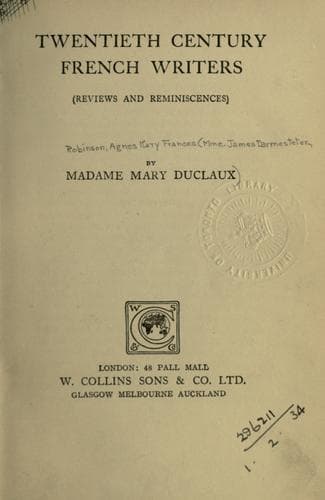
Twentieth Century French Writers: Reviews and ReminiscencesRobinson, A. Mary F. (Agnes Mary Frances)
History
Twentieth Century French Writers: Reviews and Reminiscences
Robinson, A. Mary F. (Agnes Mary Frances)
French literature -- 20th century -- History and criticism
Was he a great poet? It is perhaps too soon to say. Bad taste never yet
prevented any one from being a great poet. This is a point on which I
cannot insist too strongly. When Juliet says:--
‘Give me my Romeo and when he shall die,
Take him and cut him out in little stars,
And he shall make the face of heaven so fine
That all the world shall be in love with night.’
Shakespeare is writing Rostand with a vengeance.
When in Victor Hugo’s _La Forêt Mouillée_ the sparrow makes believe
his woodland glade is the court of Louis XIV., and says in a series of
puns, first of all, to a tuft of heather (bruyère):--
‘Bonjour,
La Bruyère! (à une branche d’arbre)
Bonjour, Rameau!
(à une corneille sur le rocher)
Bonjour, Corneille!
(au nénufar) Bonjour, Boileau!’
let us admit at once that Victor Hugo wallows (and not in this instance
only) in the very slough of that bad taste so dear to Rostand. How
pleased Rostand would have been to call the water-lily, say, John
Drinkwater!
But then Shakespeare and Victor Hugo have amazing qualities wherewith
to counter-balance these conceits. In art, that is everything. The
smallest chip of pure gold compensates for a bag full of pebbles: a
work of art must be estimated by the degree of its merits and not
by the quantity of its defects. If there is dross along with the
gold--even though there be much more dross than gold--let us be
thankful if the gold itself is pure and unaffected by the presence of
the baser residue. There is the question.
I borrow from a book, recently published in French by a Hungarian
Professor, M. Haraszti, some details of the youth and origin of
Rostand. In 1868, he was born at Marseilles of a wealthy family of
merchants and bankers, long established there. For a hundred years, at
least, they had all been lovers of the arts. Early in the Nineteenth
Century, the quatuors of Beethoven were performed, for the first time
in France, in the Rostands’ salon. In 1844, a Mademoiselle Victorine
Rostand--a great-aunt of the poet’s--published a volume of lyrics in
the manner of Lamartine. Edmond’s uncle, the banker, Alexis Rostand,
has composed an opera and more than one oratorio; and his father,
the economist Eugène Rostand, is himself a poet. A volume of verse,
_Les Sentiers Unis_, published in 1876, celebrates the precocity and
charm of the child, Edmond, at that time eight years old; and it is
interesting to learn that, even at that early date, he was remarkable
for his original grace of words and flow of language:--
‘Cette petite langue exquise,
Un vrai jargon de Paradis,
De mots qu’il façonne à sa guise.
De diminutifs inédits;
D’inimitables tours de phrases....’
Public-domain text, read in full here on John Shaqi.
Reviews
Reviews
No reviews yet
Be the first to share your thoughts on this work.
Join the Discussion
Join the discussion
Sign in to leave a comment or review.
Sign InorCreate an account