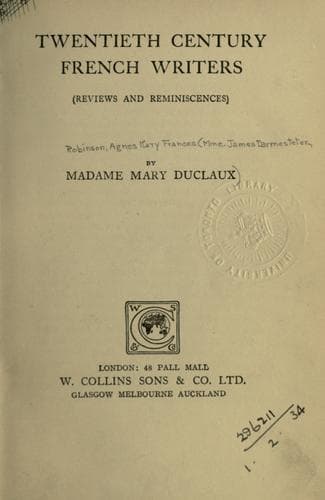
Twentieth Century French Writers: Reviews and ReminiscencesRobinson, A. Mary F. (Agnes Mary Frances)
History
Twentieth Century French Writers: Reviews and Reminiscences
Robinson, A. Mary F. (Agnes Mary Frances)
French literature -- 20th century -- History and criticism
In order to encourage and enlighten this hypothetical translator, I
will run through the plots of the principal of these dramas. It is not
an easy task, for no sooner has Claudel accustomed his readers to a set
of characters, than he is out with a second version of the same play;
and lo! in the twinkling of an eye, all is changed. I do not advise my
imaginary translator to begin with the first of these pieces, _Tête
d’Or_, which is really intolerably prolix. Yet there is much that is
fine and moving in the sombre, magnificent pictures which show us the
folly of individualism. The hero staggers on the stage, like Lear
burdened with the dead body of Cordelia, carrying the corpse of his
young wife; he is young and strong, but he has not been able to save
her; and under the beating rain in the open field, he digs her grave
and lays her there:--
‘Va là, entre dans la terre crue! À même! Là où tu n’entends plus
et ne vois plus, la bouche contre le sol.
‘Comme quand, sur le ventre, empoignant les oreillers, nous nous
ruons vers le sommeil!
‘Et maintenant je te chargerai une charge de terre sur le dos!’
Simon is the man of action, the strong man, the soldier. He becomes a
popular general, a sort of Bonaparte, whom his soldiers, on account
of his touzled, yellow curls, call Goldilocks: Tête d’Or. And, in the
second act, he returns from a brilliant victory having redeemed his
country. But he finds his one friend dying. This poor lad implores
the hero to save him--or, at least, to console him. And Goldilocks
discovers the limits of his power! Finally he himself, though a king
triumphant, perishes as miserably.
‘Que je grandisse dans mon unité,’ cried Goldilocks. But one man
alone, however great, is little; and his last words are: ‘Je n’ai
été rien.’
This play was written by the unregenerate Claudel; it shows a nature
born to mysticism and religion, with as yet no active faith. A few
years later, we find our poet the most convinced of Catholics. Like the
poet, Cœuvre (in his play, _La Ville_), we leave him, at the end of the
second act, a simple dilettante; and when next the curtain rises we
find him resplendent in priestly vestments. Not that Claudel has ever
actually taken orders, yet in his own way he is a priest and ordained
to a ministry. He, too, has found in thought a second birth--‘dans la
profondeur de l’étude, une seconde naissance.’
And now he writes to promulgate his certitude. Man does not live for
man but for God; the happiness of self is an illusion; the soul alone
exists; the only true order is based on sacrifice and association: such
is the lesson that all his plays expound.
Public-domain text, read in full here on John Shaqi.
Reviews
Reviews
No reviews yet
Be the first to share your thoughts on this work.
Join the Discussion
Join the discussion
Sign in to leave a comment or review.
Sign InorCreate an account