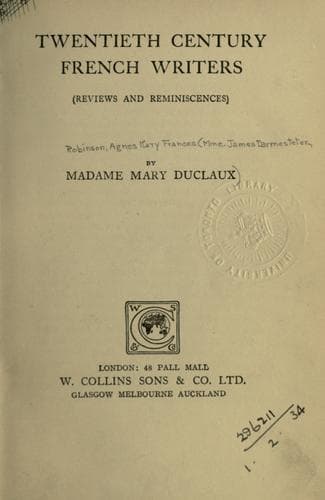
Twentieth Century French Writers: Reviews and ReminiscencesRobinson, A. Mary F. (Agnes Mary Frances)
History
Twentieth Century French Writers: Reviews and Reminiscences
Robinson, A. Mary F. (Agnes Mary Frances)
French literature -- 20th century -- History and criticism
_La Jeune Fille Violaine_ is an early study for Claudel’s masterpiece,
_L’Annonce faite à Marie_. It is a modern play, a touching, romantic
story, not unlike the work of the modern Irish school. The setting
is a large farm near Soissons. The heroine, Violaine, is the elder
of the two daughters of the house. Because she is so happy and he so
miserable, the young girl bestows an innocent kiss on Pierre de Craon,
the hydraulic engineer, who loves her and whom she cannot love; she
embraces him ‘en tout bien et tout honneur;’ but, just as her fresh
lips are on her lover’s cheek her jealous younger sister, Mara, opens
the door and stealthily witnesses their farewell; and Mara thinks that
her sister is the man’s mistress.
Their father, Anne Vercors, the master of the farm, is forced to leave
his home for America, where his brother has died, to go to the relief
of two young nephews. Before setting out on so long a journey, he
wishes to marry one of his daughters to a young neighbour, Jacques
Hury, an active and honourable man, capable of managing the land.
Violaine is the eldest; Violaine shall be the bride, and, having
celebrated their betrothal, the farmer sets out consoled.
Violaine loves her promised husband. Alas, the treacherous Mara loves
him too! She tells Jacques of her sister’s kiss, and suggests that
Violaine’s love is given to Pierre de Craon. She confides her own
desperate passion to her mother--vows she will hang herself in the
woodshed on the wedding-day.
‘Tell Violaine,’ she says, ‘tell Violaine.’
And Violaine gives up her hope of happiness in order to save her sister.
Mara is not yet satisfied: Mara the practical, Mara the unanswerable,--
‘You cannot stay here _now_,’ she says to the sad Violaine. ‘And I
suppose you will hardly again think of marrying? Every one knew you
were betrothed to Jacques.’
‘No,’ says Violaine, ‘I do not think of marrying.’
‘Then, in that case, you may as well give me your half of the
farm! What use would it be to you, if you do not live with us, and
if you do not marry? Come, sign! Here is the pen!’
And then, while Violaine signs away her birthright, Mara seeks in the
hearth a handful of wood ashes to pounce the signature, and having
dried the writing, flings the remainder of the hot, stifling dust in
her sister’s face. And she laughs, coarse and gay; but the ashes set up
an inflammation that ends by blinding Violaine for life.
Public-domain text, read in full here on John Shaqi.
Reviews
Reviews
No reviews yet
Be the first to share your thoughts on this work.
Join the Discussion
Join the discussion
Sign in to leave a comment or review.
Sign InorCreate an account