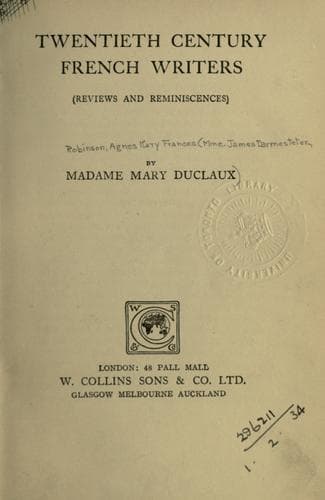
Twentieth Century French Writers: Reviews and ReminiscencesRobinson, A. Mary F. (Agnes Mary Frances)
History
Twentieth Century French Writers: Reviews and Reminiscences
Robinson, A. Mary F. (Agnes Mary Frances)
French literature -- 20th century -- History and criticism
When the third act begins, several years have passed. Violaine, an
outcast and a beggar, a sort of pious wise-woman, lives alone in a
wood. The peasants revere her as a saint, and indeed her virtues are
acceptable in the sight of Heaven, so that she performs many miracles.
(This situation in a modern play appears less far-fetched than it would
in England among the fields of France, where the wise-woman and the
sorcerer, the ‘meije’ and the ‘rebouteux’ and the ‘jetteuse de sorts,’
with their herbs and their charms and their clever massage, still
play so large a part in the life of the remoter villages.) The art of
Violaine is much esteemed by the simple rustics that know neither her
name nor her birthplace. And so one day, in order to consult the wise
woman of the wood, Mara sets out with her first-born, blind from birth.
She knows not whom she goes out in the wilderness to see, as she joins
company with a poor woman bent on the same quest. They track the healer
for some while vainly, through a wood, in the snow:--
_La Femme_: Si c’est pas un malheur de courir les bois comme ça à
mon âge! Pour sûr que ça me fera pas de bien!
_Mara_: Alors on ne sait pas où elle gîte?
_La Femme_: Un jour ici, l’autre ailleurs. Et puis des mois sans
qu’on la voie. Faut la traquer comme une bête.
Et comme ça, votre petit est aveugle?
_Mara_: Oui.
_La Femme_: Moi, j’ai mal dans le corps. (_Silence. Il neige._)
* * * * *
_Mara_: Alors c’est des miracles qu’elle fait?
_La Femme_: Y a pas de miracles, que vous êtes simple! C’est ce
qu’on appelle la ‘force,’ voilà!
Y a pas de miracles. C’est seulement la ‘force’ vous comprenez? On
m’a bien expliqué tout ça.
At last Mara finds the wise woman in a cavern, and blind Violaine gives
to her sister’s child the gift of sight.
The fourth act brings us back to the farm. Mara, incurably jealous,
has murdered Violaine, and left her for dead in a ditch. But Pierre
de Craon has found her body, and brings her back to her old home,
still breathing, though blind and bleeding. Jacques Hury opens to them
and sees, all mangled, murdered, the broken form of the woman whose
fresh youth he had loved. Violaine tells him all. She dies forgiving,
reconciling, everybody--even the murderous Mara who, in her dreadful,
jealous, earthly way, had after all ‘loved much.’ Mara, not Violaine,
was the mother of the child! And we divine that Mara is Profane Love,
and Violaine that other Love.
‘L’Amor che muove il sole e l’altre stelle.’
Quite recently, in 1912, Paul Claudel has made the symbol clearer in
a new version of his play _The Angelus_ _(L’Annonce faite à Marie)_,
though it is at some expense of the fresh, primitive grace, the Celtic
charm of the earlier conception. There is something artificial, stiff,
consciously pre-Raphaelite in _L’Annonce faite à Marie_, but also a
rare spiritual beauty.
Public-domain text, read in full here on John Shaqi.
Reviews
Reviews
No reviews yet
Be the first to share your thoughts on this work.
Elsewhere in the archive
Join the Discussion
Join the discussion
Sign in to leave a comment or review.
Sign InorCreate an account