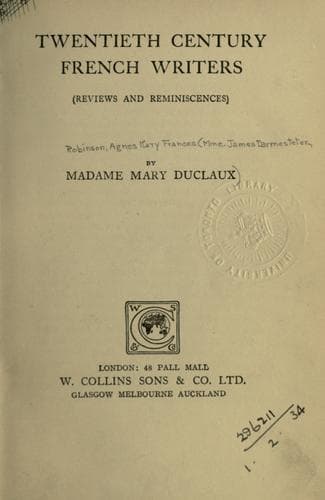
Twentieth Century French Writers: Reviews and ReminiscencesRobinson, A. Mary F. (Agnes Mary Frances)
History
Twentieth Century French Writers: Reviews and Reminiscences
Robinson, A. Mary F. (Agnes Mary Frances)
French literature -- 20th century -- History and criticism
In the second version, place and personages remain unchanged, but the
time is altered; we are no longer modern but plunged in the early
Middle Ages. Anne Vercors, the master of the farm, leaves his home not
on an errand of charity to America, but in order to join the Crusade.
Pierre de Craon, instead of canalising rivers, builds cathedrals: he
is a great master-mason, so gifted that, by a special dispensation he
is allowed at large, although a secret leper. And Violaine’s kiss of
compassion infects her with his disease.
This seems to me a grave artistic error, since to some extent it
exculpates the faithless Jacques, the cruel Mara, who follow but the
fashion of their age in driving a leper from her home. But the end:
the death of Violaine, stifled under a cartload of sand, from which
the treacherous Mara has drawn the back panel; and the return of Anne
Vercors; and the relative repentance of the obstinate Mara; and the
great mystical wind that rises and uplifts us into a region where
happiness and tragedy are lost in a peace beyond understanding--all
this moves us deeply in the second rendering.
Each version has its beauties, and either makes us realise the Celtic
base of France--at least, of the north of France. The French have ever
Rome upon their lips, and their education has been strictly Latin since
the time of the Gallo-Romans, but, by instinct and blood, they are
Celts: no deep racial difference divides a Paul Claudel from a Synge,
or a Barbey d’Aurevilly from a Walter Scott.
_La Jeune fille Violaine_ presents no great difficulties to a
reader broken in by a sufficient course of recent Irish literature.
_L’Échange_ is simpler still--one of the most spontaneous and
agreeable, as also one of the earliest of Claudel’s pieces. It is a
little tragedy with four personages: Louis Laine, an adventurer, a
libertine, a man incapable of discipline or of order--in fact, an
Individualist, and, as such, abominable in the sight of Paul Claudel;
his wife, the pure girl he has eloped with, a Frenchwoman of a type
which Claudel is never weary of reproducing. Laine, an American,
has carried off his French bride to the New World, a land whose
traditions and conditions are contrary to all her experience. Louis
Laine incarnates the mercantile American spirit, but he knows nothing
of its energy, its initiative; qualities swiftly apprehended by the
self-possessed and diligent Marthe. She says to the Yankee, Laine’s
employer, Thomas Pollock Nageoire (Finn):--
‘Thomas Pollock, il y a plusieurs choses que j’aime en vous.
‘La première c’est que, croyant qu’une chose est bonne, vous ne
doutez pas de faire tous vos efforts pour l’avoir.
‘La seconde, comme vous le dites, c’est que vous connaissez la
valeur des choses, selon qu’elles valent plus ou moins.
‘Vous ne vous payez point de rêves, et vous ne vous contentez point
d’apparences, et votre commerce est avec les choses réelles.
Public-domain text, read in full here on John Shaqi.
Reviews
Reviews
No reviews yet
Be the first to share your thoughts on this work.
Elsewhere in the archive
Join the Discussion
Join the discussion
Sign in to leave a comment or review.
Sign InorCreate an account