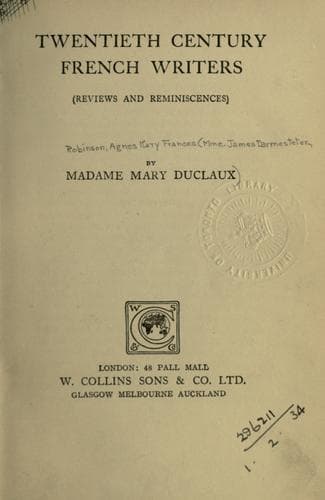
Twentieth Century French Writers: Reviews and ReminiscencesRobinson, A. Mary F. (Agnes Mary Frances)
History
Twentieth Century French Writers: Reviews and Reminiscences
Robinson, A. Mary F. (Agnes Mary Frances)
French literature -- 20th century -- History and criticism
As he explained in a recent letter to the _Figaro_, his personages
mean more than meets the eye. Aware of the symbolism of our poet,
mindful that he is essentially a pupil of Mallarmé, a subtle critic
has already interpreted _L’Échange_: Marthe was the Catholic Church;
Laine, her seducer, was the Romantic spirit; Thomas Pollock, the friend
to whom in her distress she reaches her hand, was to stand for the
spirit of social activity. Nothing could be neater than this gloss,
so admirably typical of our times; and I think, for my part, that
Paul Claudel would have been wise to leave his ingenious scholiast in
possession of his commentary.
When a poet is so obscure that he needs a Browning Society or a Dante
Society, or a Claudel clique, to discover his meaning, he should never
turn on his interpreters, pointing-pole in hand; it is not playing
the game. They have found out something--perhaps better than what he
originally meant. M. Claudel, however, informs us of his real intention.
_L’Échange_ was written in 1893 and 1894, at New York and Boston, where
the young poet was occupied in the Consular service, and this melodrama
is in reality a lyric, an expression of his own feelings during those
first years of administrative exile:--
‘I realised at last those old dreams of flight and travel to which
my hero, Louis Laine, gives expression; and yet my heart was full
of homesickness, of the sense of strangeness, of not belonging
to my surroundings: my second personage, Marthe, expresses this
regret of my native land.... From another point of view, the play,
which is the drama of exile, is also that of a young man, a poet,
obliged to choose between two vocations, apparently contradictory:
on the one hand, free love, independent life, unfettered fancy,
art; on the other hand, the obstinate, divine, conservative forces:
conscience, family, religion, the Church, and a man’s sworn faith.’
But these symbolic forms of art should enjoy the divine liberty of
music. Like Calverley’s lyric ‘the meaning is what you please’; or as
Claudel himself puts it:--
‘L’intérêt d’un drame doit dépasser l’anecdote qu’il raconte;
il veut dire quelquechose; quelquechose de général et qui n’est
étranger à aucun des spectateurs.’
Public-domain text, read in full here on John Shaqi.
Reviews
Reviews
No reviews yet
Be the first to share your thoughts on this work.
Elsewhere in the archive
Join the Discussion
Join the discussion
Sign in to leave a comment or review.
Sign InorCreate an account