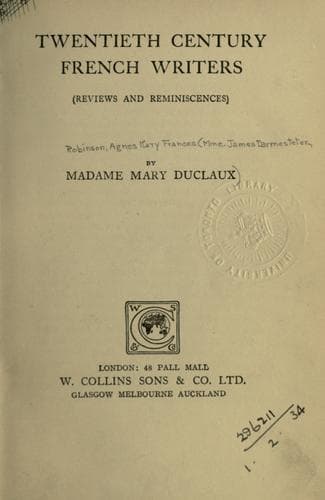
Twentieth Century French Writers: Reviews and ReminiscencesRobinson, A. Mary F. (Agnes Mary Frances)
History
Twentieth Century French Writers: Reviews and Reminiscences
Robinson, A. Mary F. (Agnes Mary Frances)
French literature -- 20th century -- History and criticism
All Claudel’s dramas are symbols; all of them tend to the condition
of music; and yet all of them are profoundly impregnate with his
individual experience. They take place all over the globe, because
Claudel, a pupil of the School of Political Sciences, has followed
the consular career in many climates. He has visited India, Japan.
He has spent years of his life in China, in Bohemia, at Frankfort,
in Switzerland. He is almost as great a traveller as Loti. But the
multiplicity of experience, the knowledge of many men and many ways
of life, which in Loti’s case has increased an innate tendency to
scepticism--deepening it to an intellectual nihilism--has sent Claudel
off at a tangent back to the unquestioned certitudes of his childhood’s
prayers: he dare not be less than the devoutest Catholic, for that
way madness lies. Faith with him is an appetite, almost a carnal
satisfaction.
The theme of _L’Échange_--the incompatibility of Action and the
Soul--is the subject of one of the most intense and original of
Claudel’s plays, _Partage de Midi_, a play revered and cherished by
the poet’s esoteric admirers partly, no doubt, on its own considerable
merits, but also because it is not to be bought. (It was published in
an edition of a hundred and fifty copies for the benefit of a chosen
few, admitted to this record of a private experience, so enveloped in
symbolism that, of those hundred and fifty, perhaps, not fifteen could
lift the veil.)
Here again four personages fill the stage: Ysé, who is just woman,
as Eve was woman, all passion, instinct, sex, all beauty, freshness,
grace, as devoid of a spiritual soul as any houri; her husband, De Ciz,
a gentle, inefficient man of pottering mediocrity; Amalric, the man of
action, the adventurer, the Empire-builder, the colonial à la Kipling;
and Mesa, the mystic, the virgin, the visionary, the man for whom there
is but one thing needful. And all these men belong to Ysé in turn.
The theme is double: first, the gradual conquest of Parseval by
Kundry--of the imaginative and spiritual man by the instinctive woman.
Neither has grasped the secret of love, but Ysé at least apprehends
it:--
_Ysé_: L’amour même?... Ça, je ne sais ce que c’est.
_Mesa_: Eh bien, ni moi non plus.... Cependant, je puis comprendre.
_Ysé_: Il ne faut pas comprendre, mon pauvre Monsieur!
Il faut perdre connaissance!
And for the full space of a year Mesa loses, in the arms of Ysé, that
consciousness of a fuller life, hidden behind the tattered screen of
appearances, which had long been to him the _Unum necessarium_.
Public-domain text, read in full here on John Shaqi.
Reviews
Reviews
No reviews yet
Be the first to share your thoughts on this work.
Elsewhere in the archive
Join the Discussion
Join the discussion
Sign in to leave a comment or review.
Sign InorCreate an account