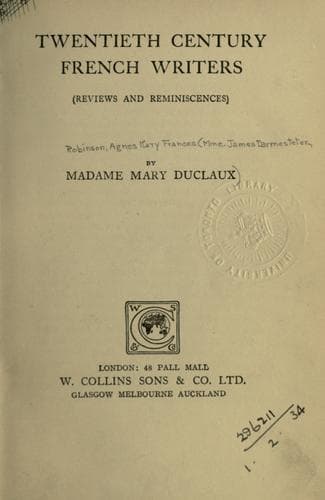
Twentieth Century French Writers: Reviews and ReminiscencesRobinson, A. Mary F. (Agnes Mary Frances)
History
Twentieth Century French Writers: Reviews and Reminiscences
Robinson, A. Mary F. (Agnes Mary Frances)
French literature -- 20th century -- History and criticism
But Mesa has his revenge. We make acquaintance with these four persons
on a ship sailing eastwards, just as they cross the line. De Ciz is an
errant engineer, in search of employment: Amalric is a trader ruined
yesterday, but sure of his million to-morrow; Mesa is, by his worldly
situation, a sort of Sir Robert Hart, a great functionary, equally
indispensable to the Europeans and the Chinese, but by temperament he
is a mystic, meditating the full oblation, hesitating whether or no he
shall embrace the life of a monk. Ysé is a new world to the visionary
Mesa:--
‘Il fait bon près d’une femme!
On est comme assis à l’ombre et j’aime à
l’entendre parler avec une grande sagesse,
Et me dire des choses dures, malignes,
Pratiques, bassement vraies, comme les femmes savent en trouver.
Cela me fait du bien.’
The second act is two long duets in the cemetery of the Hong Kong
Happy Valley. The first between Ysé and her husband, who leaves her on
an expedition to Siam; the second between Ysé and Mesa, who, like a
greater mystic, has sent the husband to a place of danger in order that
the fair Bathsheba may be his own.
_Photo: Dornac_ _To face p. 88_
[Illustration: =Paul Claudel=]
But the third act is a surprise. The scene opens in the great
first-floor living-room of a European factory or store in Southern
China. It is evening; all is peace within; Ysé is alone in her white
tea-gown, her yellow hair loosely plaited for the night; a babe sleeps
in its cradle; but without rages the thunder of cannon with the shrieks
of a pillaged city, sacked by fanatics. The Boxers in revolt are
ravaging the Concession; this sole building, the strongest, still holds
out against them.
To Ysé, anxiously watching, enters her protector; and, oh, most
dramatic surprise!--it is not Mesa; it is Amalric! And yet we learn the
child is Mesa’s. The man of action has carried off the love and the son
of the dreamer: all the profits of life are for him. This night the
lovers are to die. As club after convent, store after villa, fall into
the hands of the screaming insurgents, Amalric (ever the man of action,
and even in this tragic hour cheerful, limited, master of his fate)
neatly adjusts the mechanism of an infernal machine which, before the
Chinese can break down the gates and bolts of the great factory, will
blow the house, its inhabitants, and its assailants high in the air,
shattered to dust in the twinkling of an eye:--
_Ysé_: Et cependant il est terrible d’être morte.
(_Elle se trouble et lui prend la main._)
... Et, Amalric, est ce que vraiment il n’y a point de Dieu?
_Amalric_: Pourquoi faire? S’il y en avait un, je te l’aurais dit.
Public-domain text, read in full here on John Shaqi.
Reviews
Reviews
No reviews yet
Be the first to share your thoughts on this work.
Elsewhere in the archive
Join the Discussion
Join the discussion
Sign in to leave a comment or review.
Sign InorCreate an account