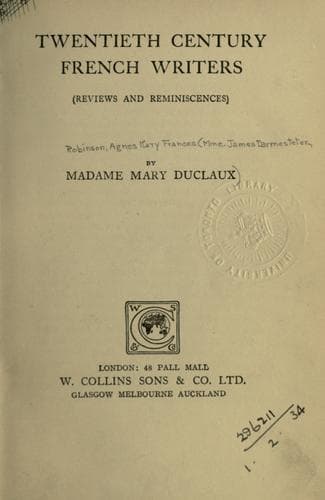
Twentieth Century French Writers: Reviews and ReminiscencesRobinson, A. Mary F. (Agnes Mary Frances)
History
Twentieth Century French Writers: Reviews and Reminiscences
Robinson, A. Mary F. (Agnes Mary Frances)
French literature -- 20th century -- History and criticism
But here comes Mesa; he has a pass from the insurgents which permits
him to go where he will; he comes to save Ysé. Amalric furious at the
sight of his rival, leaps at him with one bound, wrestles with him,
flings him off, broken, unconscious, his shoulder out of joint. And
he takes from Mesa the talisman which will save their lives, as he
has already taken his love and his child. Then, leaving Mesa still in
his deep swoon, he carries Ysé down to the harbour, where a ship is
waiting, just under the walls.
While Mesa still stirs and murmurs in his swoon, Ysé returns; Amalric
thinks her safe in her cabin. But let Amalric live, let Amalric
prosper! She will choose rather to die with Mesa in voluntary
expiation. Like Gretchen, in Gœthe’s _Faust_, Ysé forgoes her chance
of life; she will risk the great adventure of Eternity: ‘L’esprit
vainqueur dans la transfiguration de Midi.’ And these last words
explain the enigmatic title: Midi, Noon, is earthly passion which must
be purified by suffering and sacrifice before it content the soul.
The Sharing of Noon, _Le Partage de Midi_, would make an admirable
opera for the music of a Claude Debussy.
To my mind, the most interesting of Claudel’s plays, is _L’Otage_ (The
Hostage), an historical piece in the sense that our poet has captured
the atmosphere and character of the period he revives. Though, as for
the facts, he invents them at his pleasure. This is the more startling
that the time is 1814, and among the personages are Louis XVIII. and
Pope Pius, whose ghosts must be surprised to learn some of their
adventures.
We are at the end of the First Empire; Napoleon has the Pope safe
in his keeping, a prisoner; so far so good. But here Claudel parts
company with History. He imagines that a Royalist conspirator, the
Vicomte de Coûfontaine, carries off the Pope by a deed of derring-do,
and conveys him by night to a half-ruined abbey hidden in the woods
of Picardy--all that is left of his family estate. Coûfontaine is
an émigré, a dangerous exile, with a price set on his head, and the
abbey is inhabited by a young girl, his cousin, Mademoiselle Sygne de
Coûfontaine, who lives there in great retirement, striving by endless
patience, tireless economy, to piece again together the tattered
fragments of the family fortunes--not for herself, but for the little
children of that exiled cousin whom, half-unwittingly she adores.
Public-domain text, read in full here on John Shaqi.
Reviews
Reviews
No reviews yet
Be the first to share your thoughts on this work.
Elsewhere in the archive
Join the Discussion
Join the discussion
Sign in to leave a comment or review.
Sign InorCreate an account