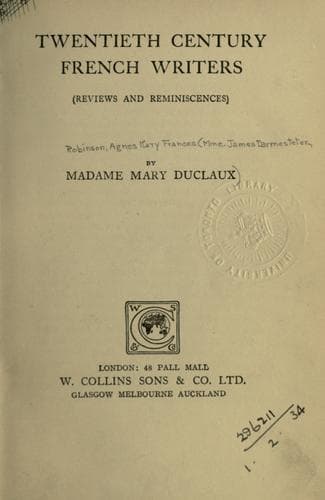
Twentieth Century French Writers: Reviews and ReminiscencesRobinson, A. Mary F. (Agnes Mary Frances)
History
Twentieth Century French Writers: Reviews and Reminiscences
Robinson, A. Mary F. (Agnes Mary Frances)
French literature -- 20th century -- History and criticism
The opening scene is exquisite: its delicate yet homely poetry recalls
Carpaccio’s Saint Ursula asleep. But Sygne keeps vigil. She is alone
by night in the library of her abbey. The books of the exiled monks
line the walls; on the one side left bare, a Christ of bronze is nailed
to a huge blackened cross made of the charred beams of the Château de
Coûfontaine, burned under the Revolution. The tall shuttered windows
have no curtains. There is no carpet on the speckless floor, where
the very nails are burnished. Great solemn chairs are ranged against
the wall. In one corner, on a wicker hurdle, the harvest of plums is
laid out to dry. In another corner of the huge bare place the young
mistress of the abbey has established her abode; over her head, sole
ornament, is hung a torn fragment of tapestry, snatched from the
burning, blazoned with the arms of Coûfontaine. In front of her, a
pretty old-fashioned bureau is covered with ledgers and files of papers
neatly tied. Close by a little table is spread with bread and wine and
the cold meat for a frugal supper, as though some belated visitor might
be expected.
Coûfontaine arrives in the dead of night; he brings with him an
old nameless priest for Sygne to house and hide; the girl does not
guess it is the Pope. She greets her cousin with quiet joy, and with
a girlish pride shows him her filed accounts, her savings, all the
store accumulated for the two exiled children whose miniatures stand
on her writing-table. But both little ones are dead; the scarlet fever
has killed them over in England. And their mother is dead too, their
mother who had betrayed hearth and home, their mother who had been the
Dauphin’s mistress. Coûfontaine is a desolate man, beset with bitter
memories. What future is there for the race of Coûfontaine? The scene
closes on a betrothal. But (as in Corneille’s _Polyeucte_) the hearth
of plighted love is destined to be shattered by the stroke of Grace,
and the act of God.
Public-domain text, read in full here on John Shaqi.
Reviews
Reviews
No reviews yet
Be the first to share your thoughts on this work.
Elsewhere in the archive
Join the Discussion
Join the discussion
Sign in to leave a comment or review.
Sign InorCreate an account