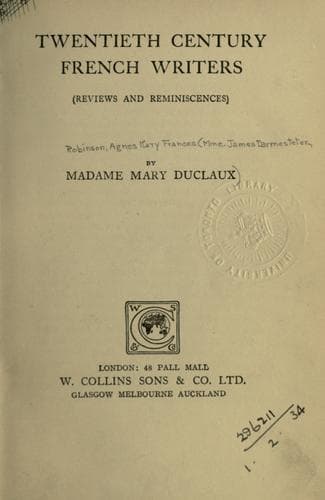
Twentieth Century French Writers: Reviews and ReminiscencesRobinson, A. Mary F. (Agnes Mary Frances)
History
Twentieth Century French Writers: Reviews and Reminiscences
Robinson, A. Mary F. (Agnes Mary Frances)
French literature -- 20th century -- History and criticism
There are passages of Shakespeare, there are _Pensées_ of Pascal,
which we contemplate, as it were, in an atmosphere of moral beauty,
a halo, a luminous aura, through which they shine transfigured and
augmented. They certainly mean more to us than to the most admiring
of their contemporaries: their words have been messages to so many
passionate and earnest souls! This phenomenon of accretion is the
reward of the obscure: they only, like the saints of Afghanistan,
continue to grow in their graves. An Addison, a Voltaire, however
great, means what he has always meant. But your obscure genius, in time
to come, will be either a gospel or a Gongorism; there’s no third state
for him.
FRANCIS JAMMES
Francis Jammes is a Faun who has turned Franciscan Friar. As we read
his early poems, his delicious rustic prose, we seem to see him sitting
prick-eared, in some green circle of the Pyrenees, with brown hands
holding to his mouth a boxwood flute, from which he draws a brief,
sweet music, as pure as the long-drawn note of the musical frog, as
shrill as the plaintive cry of some mountain bird who feels above its
nest the shadow of the falcon.
And then he met Paul Claudel and was converted.
After all, little was changed, for his innocent paganism had been
tinged with natural piety, and in his religion he might say, like the
Almighty, in the _Roman de Lièvre_,--
‘J’aime la terre d’un profond amour. J’aime la terre des hommes,
des bêtes, des plantes et des pierres.’
Only henceforth we see him, in our imagination, like Saint Francis,
with a monk’s hood drawn over his brow, sandals on his feet, his brown
gown cinctured with a knotted cord, a couple of doves hovering over his
shoulders, and, at his side, fawning and faithful, a converted wolf....
I met M. Jammes at Madame Daudet’s house one winter, and, in fact, his
appearance was not wholly unlike this fancy portrait. The gown was a
brown woollen suit, but just the Franciscan colour. Above the ruddy,
jocund, rustic face, a crown of grizzling curls, behind which Nature
had provided the tonsure. Neither dove nor wolf, but, in their stead,
all the young Catholic poets of Paris, pressed in serried ranks to
meet the Master who, for a few days, had consented to quit his beloved
solitude of Orthez.
We can remember a different Francis Jammes. The poet has said of
himself, ‘My soul is half the soul of a Faun, and half the soul of a
young girl.’ But let me quote an admirable strophe from his _Le Poète
et sa Femme_:--
Public-domain text, read in full here on John Shaqi.
Reviews
Reviews
No reviews yet
Be the first to share your thoughts on this work.
Elsewhere in the archive
Join the Discussion
Join the discussion
Sign in to leave a comment or review.
Sign InorCreate an account