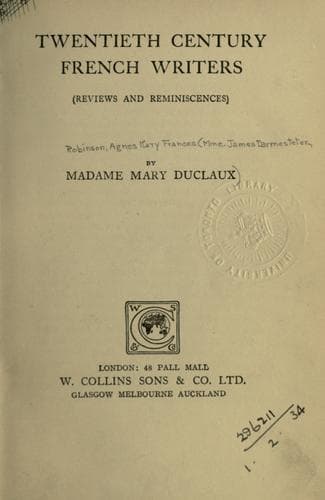
Twentieth Century French Writers: Reviews and ReminiscencesRobinson, A. Mary F. (Agnes Mary Frances)
History
Twentieth Century French Writers: Reviews and Reminiscences
Robinson, A. Mary F. (Agnes Mary Frances)
French literature -- 20th century -- History and criticism
While Toussaint drinks and sings with the Imperial captains, he leaves
his sick wife to draw up a secret treaty with an emissary of the lawful
king of France--for he meditates a timely treason, à la Talleyrand.
Need I say that King Louis’s envoy is the Vicomte de Coûfontaine? Need
I add that their negotiations are varied by the cruel reproaches of
Coûfontaine, by the broken-hearted disculpations of Sygne. ‘Is there
anything higher than Love?’ says he; ‘is there anything deeper than
one’s Race? You have been a traitor to your heart and your blood.’
‘There is God,’ says Sygne,--
‘J’ai sauvé le Prêtre éternel.’
But Coûfontaine will not be convinced. At least he will wreak his
vengeance on the usurper. So, having signed the papers which bring
the king to his own, having carried them off, he takes, through the
open French window, a parting shot at Toussaint Turelure, which Sygne
intercepts, receiving it in her heart, while Turelure, with a shot of
his pistol, kills the aggressor. Thus the two cousins perish; their
kingdom is not of this world; yet they leave an heir: a child of the
body of Sygne, an heir to the name and the titles of Coûfontaine by
an act of legal substitution. Like Violaine, like Mesa, Coûfontaine
can leave no child: the hateful Mara, the brutal Toussaint--brief the
children of Action--can make the fruits of the spirit flourish and
multiply, and they alone.
Why does Sygne save the life of the husband she never forgives? Is
it an act of sacrifice? A homage to the sacrament? No, for she dies
unshriven because unforgiving. It is because Death is better than
Life: ‘une chose trop bonne pour que je la lui eusse laissée.’ This
heartrending last act of _L’Otage_ is especially moving in the last
version, that acted in Paris during the summer of 1914, in which, mute,
dying, relentless, Sygne opposes only silence to the blatant triumph of
her odious master. It is, indeed, the dialogue of Life and Death.
What will be the ultimate position of Claudel? It is yet too soon to
say. His influence on the writers of our time is a fact. He is still
young; he is incontestably original; he is no doubt obscure. But many
of the greatest writers were and remain obscure--Dante, for instance,
and Pascal.
In our own times, Carlyle, Browning, Whitman, Ibsen, Nietzsche, are
often mysterious. And none the less, from the date of their appearance,
they have been read with eagerness, and they continue to be read (a
little less eagerly), and, indeed, to be revered, as the bearers of a
message, by an undaunted band of followers. Like all these, Claudel
aspires to be a conductor of souls. And in the things of the spirit
a certain obscurity is no disadvantage, if there be a real message
behind it. We fill out the author’s adumbrated meaning, as we read an
intention into a fine musical phrase, and his sentence gains by all the
priceless bulk of our accumulated interpretations.
Public-domain text, read in full here on John Shaqi.
Reviews
Reviews
No reviews yet
Be the first to share your thoughts on this work.
Elsewhere in the archive
Join the Discussion
Join the discussion
Sign in to leave a comment or review.
Sign InorCreate an account