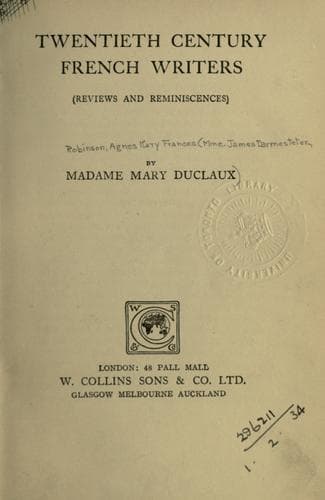
Twentieth Century French Writers: Reviews and ReminiscencesRobinson, A. Mary F. (Agnes Mary Frances)
History
Twentieth Century French Writers: Reviews and Reminiscences
Robinson, A. Mary F. (Agnes Mary Frances)
French literature -- 20th century -- History and criticism
In addition to a mind of the subtlest moral delicacy and a more
than feminine refinement, M. Boylesve possesses a literary style of
transparent ease and charm; just the style to suit the landscape he
describes, the moderate classic harmonies and Attic graces of Touraine.
He is the historian of the charming _gros bourgs_ that surround Loches
or Azay. He describes their neat, white houses built of freestone,
topped with slate, their raised stone _perrons_ (or stoops, as they say
in America) and handsome ornamented windows; and we see the trellised
vine up the front, and the flowers in the gardens, and the fruit trees
everywhere. The villages of Touraine have brought prosperity to the
very brink of poetry!
These little farms where every sunny slope all round is planted with
the vine; these old gray manors and priories nestling under some cliff
lightly planted with slender oak-woods (so unlike ours!), in which
the gray-blue periwinkle and the gray-pink cyclamen grow wild; these
prosperous rural properties, with their air of solid comfort, their
teeming vats of wine; their kitchen-gardens, full of melons, cucumbers,
asparagus, artichokes, cardoons, green peas, egg-plants, tomatoes,
salsify, and scarlet-runners; their great barns; their stone stables
where the cattle spend so much of their time (for the land is too
fertile and too valuable to lay down in pasture); all this dignified,
delightful, indolent country of Touraine has found its prophet in
René Boylesve. Except Balzac in his _Lys dans la Vallée_, no one has
described it half so well--the land and the dwellers on the land....
‘Molles Turones,’ said Cæsar, and Tacitus calls them ‘imbelles,’ and
Tasso thought the peasant here was like his field, which is ‘molle,
lieta e dillettosa.’ And, in fact, these adjectives serve very well to
describe the lazy, charming art of René Boylesve.
I find in him the moral features of his race: measure and tact,
delicacy of sentiment, love of ease, something at once noble and
voluptuous, something humorous and nonchalant, and yet, at the same
time, something precise and positive, despite his softness. And often,
when I read a novel of M. Boylesve’s, the book slips from my hands, and
I see the Plain of Touraine under its customary sky of sunny gray--its
great wide rivers, its rocky cavernous cliffs, its forests of Loches
and Amboise, its rambling lanes sunk deep between two rows of pollard
windows, the great straight white high-roads that the aspens fleck with
shadow, and all the pleasant sequence of woods and fields, which seem
to be reasonably deduced the one from the other, like the different
parts of a discourse. Did M. Boylesve know, he would be charmed; for
the object of his art is, not to hurry the reader along on a current
of breathless events, but to foster in him this habit of reverie, of
reminiscence ‘chewing the cud of sweet and bitter fancy.’
Public-domain text, read in full here on John Shaqi.
Reviews
Reviews
No reviews yet
Be the first to share your thoughts on this work.
Elsewhere in the archive
Join the Discussion
Join the discussion
Sign in to leave a comment or review.
Sign InorCreate an account