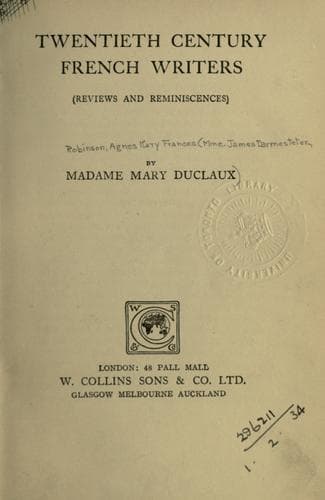
Twentieth Century French Writers: Reviews and ReminiscencesRobinson, A. Mary F. (Agnes Mary Frances)
History
Twentieth Century French Writers: Reviews and Reminiscences
Robinson, A. Mary F. (Agnes Mary Frances)
French literature -- 20th century -- History and criticism
René Boylesve was born in 1867 at La-Haye Descartes, in Touraine, and
his first book, _Les Bains de Baden_, was published in 1896; but this
belongs to the Boylesve whom we renounce. In 1899, with _Mademoiselle
Cloque_, he opened that series of ‘Scènes de la vie de province’ (as
Balzac would say), which have made his reputation. Mlle Cloque is an
old maid of narrow means; just one of those ‘churchy’ old maids for
whom Francis Jammes has expressed a respectful tenderness. But Francis
Jammes was still a ‘Faun’ when his contemporary, Boylesve, delineated
this delightful lady.
Mlle Cloque’s affections are divided between two absorbing objects,
her pretty young niece and her church. That church is the basilica of
Saint Martin, fallen into ruin; and the dearest aim of this devoted
worshipper is to restore and repair the great sanctuary of Tours. For
to her Tours is still that Jerusalem of the West that our forefathers
called it, in memory of the first confessor of the Latin Church, Saint
Martin, once the honour and glory of France, neglected now in his own
diocese.
Long before Maurice Barrès wrote his apology for the churches of
France, the author of _Mademoiselle Cloque_ showed how a great
monument may be a liberal education, may raise an illiterate mind to
heights where it apprehends the mystery which extends beneath, beyond,
appearances; he, too, affirmed that the prayer of an old woman in her
parish church may rank with the meditation of the man of science and
with the inspired presentiment of the poet.
_La Becquée_ followed _Mademoiselle Cloque_. It is impossible to
read this long, slow, humorous, enchanting book, without seeing a
resemblance (a moral resemblance, for the setting, of course, is
widely different since the setting is Touraine), still, a strong moral
resemblance to the English novel of Victorian days. Tante Félicie and
her nephew, Riquet Nadaud, remind us, though so unlike, of Aunt Betsy
Trotwood and little David Copperfield. It seems to me that those who
love the one might, at least, like the other? I shall speak again of
Riquet Nadaud in my chapter on the Novel of Childhood.
A great part of the charm of these stories is the atmosphere of
Touraine, so marvellously captured. I do not mean only the physical
atmosphere: M. Boylesve is above all things a man for whom the inner
world is important. Twenty years ago, French literature was positive,
objective, and, if I may say so, visual. But now our younger masters
are men for whom the invisible world exists; they are chiefly occupied
with the interior sphere. Some while ago, René Boylesve described this
change of front very happily to a reporter of the _Revue des Français_
(September 25, 1912). He said:--
Public-domain text, read in full here on John Shaqi.
Reviews
Reviews
No reviews yet
Be the first to share your thoughts on this work.
Elsewhere in the archive
Join the Discussion
Join the discussion
Sign in to leave a comment or review.
Sign InorCreate an account