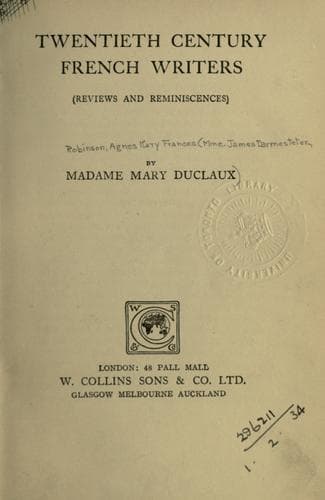
Twentieth Century French Writers: Reviews and ReminiscencesRobinson, A. Mary F. (Agnes Mary Frances)
History
Twentieth Century French Writers: Reviews and Reminiscences
Robinson, A. Mary F. (Agnes Mary Frances)
French literature -- 20th century -- History and criticism
M. Serpe has evidently a great opinion of that moral solidity which
he so much admires, for, during their married life in Paris, he takes
no pains at all to shield it, plunging his young wife into the busy,
frivolous circle of contractors, speculators, money-makers, and
pleasure-hunters that eddied round the great Exhibition of 1889. This
is the subject of _Madeleine, Jeune Femme_, which is the continued
history of his heroine--M. Boylesve’s novels have the broad full flow
and lengthy winding course of his native Loire!
Madeleine passes unscathed among the booths of Vanity Fair. But by a
friendly hearth (the one spot which recalls the peaceful surroundings
of her early years) she meets a man of letters, a student of
subtle moral problems, a lover of Pascal, an inhabitant of her own
intellectual world, yet in his private life just as much an average
sensual man as any bachelor of the Boulevards. Madeleine succumbs
at once almost without resistance to the charm of M. Juillet--she
succumbs morally, we mean, and in secret; for in the world of fact she
never succumbs at all, and her would-be seducer retires, rebuffed and
ashamed, persuaded that she is one of those impregnable fortresses it
were a waste of time to besiege, while Madeleine is half enraged by
that inalienable aureole, or aspect of virtue, which so efficiently
protects her. The flood of sentiment which invades the charmed, the
passive soul of Madeleine, its mysterious regression, and the final
triumph of her old ideals--Duty, Order, the Interior Altar--are evoked
with a magic which touches in the reader’s heart a secret spring, and
makes him share in Madeleine’s temptation, her danger, her reluctant
escape.
If Madeleine does not succumb, it was not the beautiful quality of
her soul that saved her (our author seems to say) but the regularity
and discipline of her early education; and, to point his moral still
clearer, he places in front of Madeleine a charming madcap, a dear
little modern hoyden, Pipette Voulasne. Pipette has not a bad instinct
in her composition, but neither has she a principle; she has never
heard of the spiritual combat. Pipette, too, falls in love with the
irresistible M. Juillet. Pipette is sweet and twenty, rich, unmarried
and M. Juillet is a bachelor; but the lover of Pascal hesitates at the
idea of marriage with a romp whose ideas of fun is to dress up as a
seal at a fancy ball and swim in the pond.
Public-domain text, read in full here on John Shaqi.
Reviews
Reviews
No reviews yet
Be the first to share your thoughts on this work.
Elsewhere in the archive
Join the Discussion
Join the discussion
Sign in to leave a comment or review.
Sign InorCreate an account