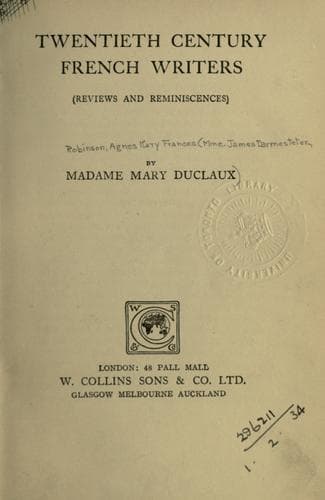
Twentieth Century French Writers: Reviews and ReminiscencesRobinson, A. Mary F. (Agnes Mary Frances)
History
Twentieth Century French Writers: Reviews and Reminiscences
Robinson, A. Mary F. (Agnes Mary Frances)
French literature -- 20th century -- History and criticism
‘In my young days, I used to visit Alphonse Daudet whom I greatly
admired. He was very encouraging, and we would talk of literature;
he used to say to me gently: “I have never described anything that
I have not seen.” He was very kind, very discreet, and I would go
away despairing, for I felt he was offering me a suggestion, a
piece of good advice. And for long afterwards I was incapable of
writing anything, since at every turn I caught myself on the point
of describing things I had never seen, could never see!’
These unseen things--emotions, beliefs, traditions, opinions, all that
makes up the moral atmosphere of a society--are the peculiar sphere
of M. Boylesve. On this occasion he showed our journalist the plan,
or scenario, for a novel which was lying on his writing-table: no
project of a plot, no list of personages, but a sequence of maxims and
reflections. ‘Take care of the moral atmosphere,’ he seems to say, ‘and
the characters will take care of themselves.’ So soon as he begins to
write, he forgets these notes, which transpose themselves into persons
and events; but his preliminary care is to invent the moral world which
naturally brings them forth.
The classic grace of his native province, its sober delicacy, its quiet
order, do not exclude a latent energy, an amorous ardour, decently
dissimulated under the discretion and retinue of a civilised and
courtly tradition. The Tourangeau is sensual as well as temperate; he
is never perverse; he is seldom excessive; none the less, if his name
be often Descartes or Berthelot, he may by chance be called Ronsard, or
Rabelais, or Balzac. How should he live in a world of such good things,
such an earthly paradise, and not know--though he discipline them--the
pleasures of sense? His purity is not austere and his piety no flaming
romantic enthusiasm.
All the delicate sensibility, all this impassioned moderation of his
native place, M. Boylesve has put into the human, touching figure
of his _Jeune Fille Bien Élevée_. It is the story of a refined and
gentle girl, convent bred, pious, reared in all the old-fashioned
dignities and delicacies of a small provincial society in Touraine.
Her parents combine for her a sensible match--a _mariage de raison_
with a Parisian architect who, visiting Chinon, has espied the white
sequestered lily; he marries the dowerless Madeleine for her perfect
manners, her charming grace, her moral solidity--_et parce qu’il ne veut
pas être_.... Poor Madeleine in her wedding veil has overheard the
unthinkable word!
Public-domain text, read in full here on John Shaqi.
Reviews
Reviews
No reviews yet
Be the first to share your thoughts on this work.
Elsewhere in the archive
Join the Discussion
Join the discussion
Sign in to leave a comment or review.
Sign InorCreate an account