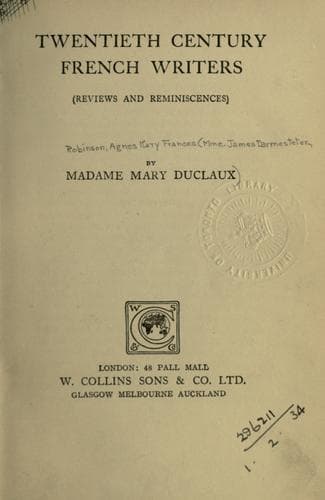
Twentieth Century French Writers: Reviews and ReminiscencesRobinson, A. Mary F. (Agnes Mary Frances)
History
Twentieth Century French Writers: Reviews and Reminiscences
Robinson, A. Mary F. (Agnes Mary Frances)
French literature -- 20th century -- History and criticism
_L’Immoraliste_ is the story of a young man, newly married, highly
gifted, with all his life before him apparently, who suddenly falls
sick of a mortal illness. Hitherto he has been a student, spiritually
minded, almost austere. But the sudden neighbourhood of death, the
dread possibility of annihilation, change his philosophy; he feels
that instinctive shudder, that sense of the futility of creeds and
conventions which Mademoiselle Lenéru has called _le sens profond de la
mort_. And his ideals are reversed.
Henceforth he esteems not the moral, not the refined, but such things
as seem especially vital: Life, in such manifestations, bad or good,
as appear the most spontaneous, the most energetic. Instinct and
Vigour draw him like a magnet, for these make for survival. At Biskra,
where he winters for his health, he finds himself admiring the little
Arab boy who steals his wife’s scissors--the scamp is so adroit, so
deft!--and when he returns to his country home in Normandy, it is the
drunkards and the poachers in the tavern who strike him as the most
alive, and therefore the most estimable. When his wife, worn out with
nursing, falls ill in her turn, he neglects her (for illness has become
in his eyes disgusting, almost monstrous) and she dies in isolation.
André Gide may be himself, perhaps, something of an Immoralist--or
rather an Amoralist--as was the manner of the _Fin-de-siècle_, but
he preserves, as the clay preserves the trace of the long crumbled
sea-shell, the imprint of a severe and religious education. Like our
English Edmund Gosse, he has left behind him a Protestant past, which
he looks back upon to-day with some distaste, and yet perhaps with
something of an unconscious nostalgia.
His best novel, _La Porte Étroite_ (1909), is laid, so to speak, on
the grave of that Huguenot youth of his, so utterly vanished, like a
handful of flowers.
‘Le goût exquis craint le trop en tout.’ These words of Fénélon’s
rise to one’s mind in reading this story of a rare soul drawn into
the abyss of the inner life, ‘as waters are by whirlpools suck’d and
drawn,’ through a sort of dread of the excess, the commonness, the
transitoriness of mortal happiness.
Alissa Bucolin was the child of a West Indian Creole and a Norman
banker, Protestant and pious. The beautiful Mme Bucolin never took root
in the Huguenot society of Havre; she spent her days swinging in a
hammock or reclining gracefully upon a couch, a shut book dropping from
her idle hand; sometimes a violent _crise de nerfs_ would interrupt the
languid course of her existence, would alarm and arouse all the quiet,
plain, provincial household; only sometimes at dusk she would awake for
a moment as it were, show a transient animation, or sit at the piano
and begin some slow mazurka of Chopin; but her lovely hands would stop
in the middle of a chord, her voice leave the phrase unfinished, and
the sleeping beauty sink again into her incommunicable _ennui_.
Public-domain text, read in full here on John Shaqi.
Reviews
Reviews
No reviews yet
Be the first to share your thoughts on this work.
Elsewhere in the archive
Join the Discussion
Join the discussion
Sign in to leave a comment or review.
Sign InorCreate an account