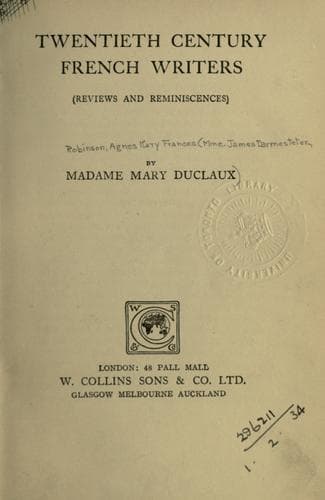
Twentieth Century French Writers: Reviews and ReminiscencesRobinson, A. Mary F. (Agnes Mary Frances)
History
Twentieth Century French Writers: Reviews and Reminiscences
Robinson, A. Mary F. (Agnes Mary Frances)
French literature -- 20th century -- History and criticism
Alissa Bucolin drew from her mother her dark romantic beauty and
a neurotic temperament, but her spiritual strain reflected the
cultured Huguenots of her father’s family. Born in the native town
of Mademoiselle de Scudéry (the author of the _Grand Cyrus_) and of
Bernardin de Saint-Pierre (the author of _Paul et Virginie_), she was
akin to the great _précieuse_ and to the idealist philosopher--and
the likeness makes us wonder if a peculiar morbid sentimentality, a
rare delicacy of emotional fibre, be usual in the inhabitants of that
flourishing seaport! Alissa had grown up in the companionship of a
sister, a brother, and a young boy cousin, two years her junior--and
from their childhood it had been understood that Alissa and Jérôme were
one day to marry.
But when the girl was sixteen years of age, the mystery of Evil, and
all the scars and scoria of mortal passion, were suddenly revealed
to her by the conduct of her mother. A novel gaiety and laughter
transfigured Mme Bucolin, coinciding with the frequent visits of a
certain young lieutenant. And one day Jérôme found Alissa weeping and
praying by her bedside while from the floor below her mother’s laughter
pealed up--unaccustomed as a portent. ‘Bucolin, Bucolin,’ drolled the
young lieutenant, ‘Si j’avais un mouton, sûrement je l’appelerais
Bucolin!’ and Alissa, weeping, murmured to her dear confidant, ‘Jérôme,
ne raconte rien à personne ... mon pauvre papa ne sait rien!’
Thus, in its very bud, the young shoot of love in her heart was
infected by shame; and she felt the longing to expiate and offer
her life as an oblation. Moreover, Juliette, three years younger
than Alissa, had let her fancy light on her young cousin; and the
serious Alissa (to whom every preference appeared a vital passion)
determined to sacrifice her dream of happiness in her sister’s favour.
Her strenuous soul was naturally inclined to sacrifice, finding in
privation that mysterious exaltation of the will, that constant and
progressive self-mastery, which animate with an intense though secret
interest the life of the ascetic.
But neither her young sister nor Jérôme would accept her oblation.
Juliette married very young a middle-aged wine grower in the south of
France, had several children, became her husband’s associate, provided
an opening for her younger brother--fulfilled, in fact, the French
ideal of feminine activity, importance, and devotedness, and was
perfectly happy; while Alissa was left (so to speak) with her sacrifice
returned unopened, left upon her hands. And Juliette’s recovery
from her first love, her happiness in a simple marriage of reason,
contributed to discredit human passion in the mind of the fastidious
Alissa:--
Public-domain text, read in full here on John Shaqi.
Reviews
Reviews
No reviews yet
Be the first to share your thoughts on this work.
Elsewhere in the archive
Join the Discussion
Join the discussion
Sign in to leave a comment or review.
Sign InorCreate an account