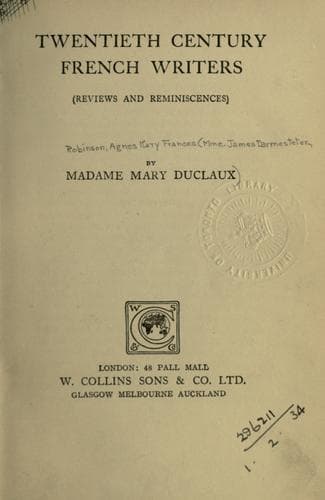
Twentieth Century French Writers: Reviews and ReminiscencesRobinson, A. Mary F. (Agnes Mary Frances)
History
Twentieth Century French Writers: Reviews and Reminiscences
Robinson, A. Mary F. (Agnes Mary Frances)
French literature -- 20th century -- History and criticism
Admirable he was, nevertheless. Patient as a peasant and courageous as
an apostle, wise and witty, bitter and gay, Péguy was full of sense and
of charity--was almost that rarest of geniuses, a saint--and failed
there (remaining merely a poet and a hero) chiefly, perhaps, because
of that insatiable vanity of his. He hungered and thirsted not only
after righteousness, but after praise. And in his lifetime he never
had his due share of it. That meed so scantily meted I might in some
small degree have swelled, and now regret my suspended judgment; but
Péguy roughed me up in every fibre, and I disapproved of him almost as
much as I admired him. There was something of Rousseau in the fiery
little autodidact with his penetrating delicacy of sentiment, and that
sore vanity of his as touchy as a gouty foot which always fears the
man across the way may stumble on it. When that aching place was hurt,
the poet, so exquisite in his sense of friendship, so abundant in his
recognition of encouragement, would surprise those most who knew him
best by certain restive or morbid quarrels--the blemishes of a too
sensitive temperament.
Despite this temperament, which was not great, there was something
really great and grand in Péguy. There was in him the most generous
passion of rescue--the desire at all risks to rush in and save. The
grandeur and misery of Man and his need of salvation was the idea which
dominated all his life. Péguy was a mystic; Time was nothing to him,
and he was sincere in saying that an act of rescue such as that which
cost him his life was worth a career of thirty years. Yes, Péguy was a
mystic, and one of the real, the greater race, no romantic idealist,
not at all vague or dreamy, but positive and practical and intensely
alive to every detail, because every fact in nature (and indeed all
the best things in industry and in art) appeared to him, in Meister
Eckhart’s phrase, ‘the words of God,’ and therefore infinitely precious
and important. One day that his friend and mine, Daniel Halévy,
that subtle and yet substantial critic, found him reading Dante’s
_Paradiso_, in view of a certain Mystery he meant to write: Le Propre
de l’Espérance (and the part, the lot, of Hope is Paradise), M. Halévy
asked the audacious poet if those whirling worlds of Dante’s and all
those whorls of singing aureoled angels did not inspire him with at
least a certain vertigo? ‘Not at all,’ replied Péguy. ‘My Paradise will
be quite different.’
‘“Il y aura dans mon Paradis des choses réelles.... Toutes les
cathédrales.” ... Et il faisait avec les deux mains le geste d’y
poser quelque chose. “Je les y mettrai.”’
And in fact (continues M. Halévy in the letter from which I am
quoting) Péguy would have admitted to his Paradise, not only the great
Cathedrals, but anything perfect in its own peculiar sphere. For
instance, he adduces:--
Public-domain text, read in full here on John Shaqi.
Reviews
Reviews
No reviews yet
Be the first to share your thoughts on this work.
Elsewhere in the archive
Join the Discussion
Join the discussion
Sign in to leave a comment or review.
Sign InorCreate an account