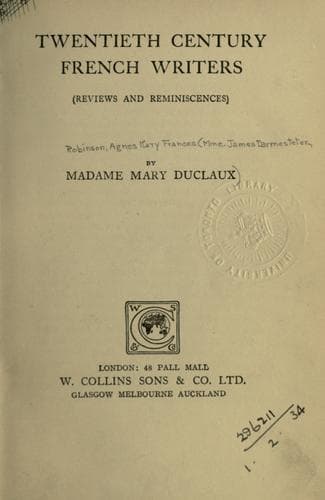
Twentieth Century French Writers: Reviews and ReminiscencesRobinson, A. Mary F. (Agnes Mary Frances)
History
Twentieth Century French Writers: Reviews and Reminiscences
Robinson, A. Mary F. (Agnes Mary Frances)
French literature -- 20th century -- History and criticism
‘this ink with which I am writing to you, which indeed was Péguy’s
ink, made of the oak, coal-black, indelible; and his pens--they too
would have gone into his Paradise, certainly, all his pens! You
have understood I am sure; Péguy extends the future life, not only
to souls and sentiments, but to all that has achieved existence;
a resurrection not only of the flesh but of the things made,
cherished, and perfected by man on earth.’
It was more or less Swedenborg’s Paradise. In Péguy’s eyes the soul
vivified and transfigured and made alive all that it touched. Hence
his utter incomprehension of all attempts to examine matter that the
soul had _not_ transfigured, his withering contempt for science and
scientists, the scorn he would pour on those miserable insects, the
‘puissants millepieds’ of the University, in their laboratories and
archives:--
‘Et ce ne sera pas ces distingués cloportes
Qui viendront nous chercher dans notre enterrement....
Et ce ne sera pas par leur usage externe
Que nous nous lèverons de notre pourriture;
Mais la Foi qui nous sauve et seule nous discerne
Saura nous retrouver dans la fange et l’ordure.’
(_Eve._)
What discussions I have had with Daniel Halévy concerning the final
value of this poem of _Eve_, whose mighty jog-trot extends interminably
over a length which exceeds the _Odyssey_ and the _Iliad_ together!
My friend, to whose opinion I attach the greatest weight, insists
on ranking Péguy with Victor Hugo for poetry and with Rabelais for
prose! And no doubt he emphasises his expressions in order to spur my
tranquil spirit to the fray. Indeed the incitement never yet failed
of its effect; I rush to the encounter; sometimes, at the point of
the bayonet, M. Halévy recedes from his position as regards Victor
Hugo; but he maintains unshaken that comparison with the creator of
Pantagruel.
Well, all that is vain; Péguy now will never fill his measure. His
monument is a broken column, like those we see in cemeteries. In these
brief passages of recollection, I may not even stay to point out the
extraordinary design and intention of that monument; nor to quote that
prose, surely unlike any other prose, which creeps up, wave after wave,
with infinite repetitions and over-lappings, until, like the tide on
the strand, it has submerged and sucked in all the subject it meant to
cover. How, in two words, could I give an idea of that style?
Public-domain text, read in full here on John Shaqi.
Reviews
Reviews
No reviews yet
Be the first to share your thoughts on this work.
Elsewhere in the archive
Join the Discussion
Join the discussion
Sign in to leave a comment or review.
Sign InorCreate an account