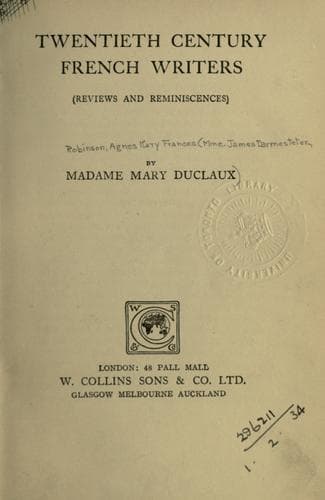
Twentieth Century French Writers: Reviews and ReminiscencesRobinson, A. Mary F. (Agnes Mary Frances)
History
Twentieth Century French Writers: Reviews and Reminiscences
Robinson, A. Mary F. (Agnes Mary Frances)
French literature -- 20th century -- History and criticism
But the first to fall was Ernest Psichari. I knew him root and
branch--knew his parents and grandparents before him, and the earliest
image that I preserve of him (since the first of all are forgotten)
is of a little lad between eight and nine years of age, unaware of my
presence in his grandmother’s drawing-room, as he talks to his little
brother in the twilight: ‘When I am grown up (says Ernest) I shall be
a great man! Et j’aurai ma statue sur tous les marchés de France!’ And
the little one of seven ripples with laughter at Ernest’s having so
satisfactorily ‘gone one better’: ‘Il y a du chemin à faire, mon frère!
(says he). Il y a bien de chemin à faire!’ Whereat I too laughed and
broke the spell, the two little boys informing me that, while waiting
for their violin-lesson, ‘on s’amusait à raconter des blagues.’
Even in Ernest’s fun there was a desire of greatness; that, and an
intense sensibility, a rare faculty of moral imagination, were what
I chiefly noticed in the child, of whom I saw less and less as his
studies absorbed him more and more: youths between twelve and twenty
have little time for their mother’s friends. A quiet young man, with
charming, living eyes, and in his whole aspect something ardent, firm,
and grave: that is all that Ernest Psichari was to me.
And then came a bolt from the blue. It was on the morrow of the
Dreyfus case when France was divided into two camps, and each faction
feverishly counted its men and the great families which centralised
these men on either side. As Daniel Halévy wrote, in a passage already
celebrated: ‘Paris a ses familles comme Florence eut les siennes, et
ses maisons, non couronnées de tours, n’en abritent pas moins des
factions guerrières.’ Ernest was born into one of these houses--one of
the most important to the Liberals--for those grandparents of his (both
dead before that shock of schism shook France to her foundations),
those grandparents of whom I have written, were Ernest Renan and
his wife. And his father was Jean Psichari, a Greek philologist of
most ‘advanced’ opinions. It came, therefore, almost as a defection,
an apostasy, when the rumour spread in the ruffled circles of the
Dreyfusards that Ernest Psichari had gone into the Army--that Renan’s
grandson, at nineteen, had enlisted as a volunteer in the Colonial
Artillery.
Public-domain text, read in full here on John Shaqi.
Reviews
Reviews
No reviews yet
Be the first to share your thoughts on this work.
Elsewhere in the archive
Join the Discussion
Join the discussion
Sign in to leave a comment or review.
Sign InorCreate an account