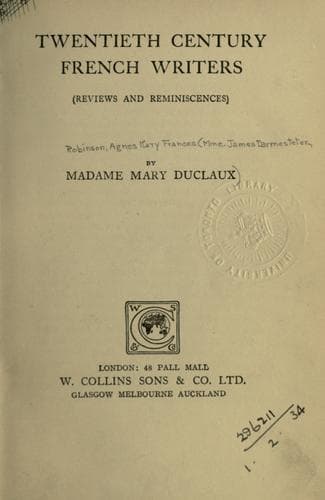
Twentieth Century French Writers: Reviews and ReminiscencesRobinson, A. Mary F. (Agnes Mary Frances)
History
Twentieth Century French Writers: Reviews and Reminiscences
Robinson, A. Mary F. (Agnes Mary Frances)
French literature -- 20th century -- History and criticism
Alas, how soon were events to show our young neophyte that
intelligence, that tenacity--that patience, ingenuity, courage,
force of will--that the most indisputable military qualities may
be associated with inhuman, with indeed a devilish perversity! But
Ernest did not live long enough to learn all the ripe iniquity of his
enemy. He fell in the very beginning of the war, at Rossignol, on the
frontiers of Luxembourg, midway between Virton and Montmédy--quite
close to Sedan, in fact; and the Germans thought to make another great
haul there.... The fight at Rossignol was a sort of southern branch
of that terrible battle of Charleroi which no living European can
ever forget. The French Headquarters, perceiving the ruse and danger
of the enemy’s plan, set on the low hill of Rossignol some twelve
thousand men, with orders to hold the heights to the last man and
shield the road beneath where the French troops were passing in one
constant stream; and the men who died there were not less heroic than
those of Thermopylæ. Twelve thousand, they were; and I am told that
scarce one of them survived.... A few are prisoners of war in Germany.
Picked men, famous regiments, the nearest thing the French possessed
to our time-hardened professional soldiers, for they were the Colonial
Infantry and Artillery. The batteries were set up, and then the storm
began. They fought all day--thirteen hours--against more than a hundred
thousand Germans, holding the passage (one cannot call it a pass, for
the hills there are too low), and, towards evening, they saw on the
horizon a moving gray mass, and thought for a moment that this meant
reinforcements. Oh, despair! they were German reinforcements! I say,
despair! for such a feeling indeed fills my breast at reading of this
supreme deception; but the young officer who gave this account to
Psichari’s mother, affirms that even then (feeling how useful was the
part they played) not despair but a noble exhilaration was the intimate
feeling of those heroes on the hill. At last the German army, creeping
steadily nearer, and distant now by no more than thirty metres,
prepared to take the last irreducible French batteries by assault.
At this moment Lieutenant X saw Ernest Psichari lead his Captain,
grievously wounded, to the _poste de secours_, immediately returning to
face the enemy. He came on with that quick half-racing, half-dancing
step which the soldiers call the ‘pas gymnastique,’ on his face a
bright excited smile, and ran with this springing gait to his battery,
standing there a moment, still smiling, as he watched the oncoming
mass. And then he fell right across his cannon--slipped heavily to the
ground; a ball in the temple had shattered that young head, so full of
dreams.
Public-domain text, read in full here on John Shaqi.
Reviews
Reviews
No reviews yet
Be the first to share your thoughts on this work.
Elsewhere in the archive
Join the Discussion
Join the discussion
Sign in to leave a comment or review.
Sign InorCreate an account