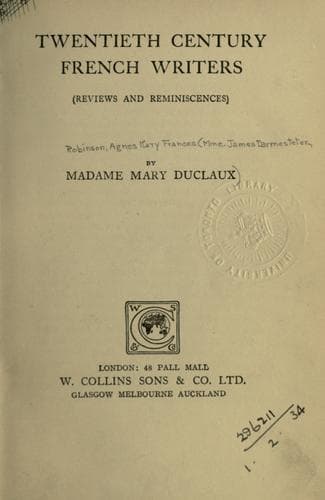
Twentieth Century French Writers: Reviews and ReminiscencesRobinson, A. Mary F. (Agnes Mary Frances)
History
Twentieth Century French Writers: Reviews and Reminiscences
Robinson, A. Mary F. (Agnes Mary Frances)
French literature -- 20th century -- History and criticism
‘Pourtant, dans sa grande peine, une consolation lui venait. Car
il croyait que le sang des martyrs était utile. Sa conviction
était que rien n’est perdu dans le monde, que tout se reporte et
se retrouve au total; ainsi tous les actes sublimes des héros
formaient pour lui une sorte de capital commun dont les intérêts se
reversaient obscurément sur des milliers d’âmes inconnues.’
(_L’Appel des Armes_, pp. 295-296.)
And the blood of the martyrs is the seed of Faith.
ÉMILE NOLLY
No man had welcomed the war with greater enthusiasm than Captain
Détanger: he wrote under the pseudonym of Émile Nolly. I was not in
Paris on that August morning when he left for Lorraine, eager (he said)
‘to water his horse in the Rhine.’ But I had bidden him good speed a
few years ago, when he set out for Morocco. Shall I ever forget the
transfiguration of that moody, noble, saturnine face? or the gleam
in the great light-gray eyes, so often sad, or even morose, and now
lit with a wild joy? or the tall, lithe figure--striding feverishly
up and down my little drawing room while, in a torrent of eloquence,
the Captain tried to explain to my languid feminine imagination
(which can only look on, and listen, and gasp in amazement) ‘la joie
du combat!’ That campaign in Morocco brought him chiefly fatigue and
disappointment, since he and his black troops had little fighting to
do, and were chiefly employed in convoying from sandy desert to sandy
desert the provisions and munitions needed on the front. It brought
him also, however, the material for a fine book--a fine, bitter,
disenchanted, weary yet energetic book, eminently characteristic of its
writer--_Gens de Guerre an Maroc_.
One of his three fine books! It was not those, however, which brought
him the celebrity, almost the fame, on which he was entering when he
fell in battle. The ardent soul of Détanger had thrown his talent
overboard, as a wandering apostle might fling from his wallet some
useless bauble and go on unencumbered save by his staff and scrip. His
last two books, the famous ones--_Le Chemin de la Victoire_ and _Le
Conquérant_--have indeed little literary grace and no sort of style;
they are like those varnished Images d’Epinal in cut-out coloured paper
which bring to the humblest cottage a sort of symbol of the wars of
Napoleon, of the glories of Turenne; or again, like the Stations of
the Cross in some wayside church. They preach a truth so august, and
in the author’s eyes so necessary to salvation, that art is of little
consequence, the one thing needful being to make the meaning plain.
That meaning was the same in each: the saving grace of the Army, and
the glorious fact that any young ne’er-do-well, any weak dilettante
creature even, so he be brave and willing to consent to discipline,
may find a personal salvation there, while building a bulwark of glory
round his country.
Public-domain text, read in full here on John Shaqi.
Reviews
Reviews
No reviews yet
Be the first to share your thoughts on this work.
Elsewhere in the archive
Join the Discussion
Join the discussion
Sign in to leave a comment or review.
Sign InorCreate an account