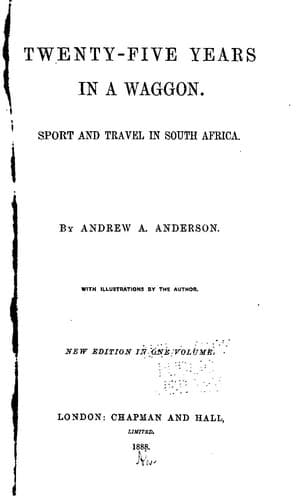
Twenty-Five Years in a Waggon in South Africa: Sport and Travel in South AfricaAnderson, Andrew A.
History
Twenty-Five Years in a Waggon in South Africa: Sport and Travel in South Africa
Anderson, Andrew A.
Africa, Southern -- Description and travel; Anderson, Andrew A. -- Travel -- Africa, Southern
The lions have been a great trouble to those who keep cattle-posts on
this river-bank; the night before my arrival, they killed a horse
belonging to Mr. Francis. Many singular isolated conical hills, over a
hundred feet in height, add greatly to the beauty of the scenery, but
are great covers for the lion and leopard. Very warm, thermometer 102
degrees in the shade. Everything very dry. Pushed on to Mongwato for
water. On my arrival there was told there was no water for oxen, and if
rain does not fall the people will have to leave the town and go down to
the Limpopo river. The chief Khama came to me and said he would take
charge of my oxen and horse, and send them to the same kraal he sent
them before, if I would send a man to look after them, with one of his,
and keep them until wanted. This kind offer was gladly accepted,
consequently I had to wait for rain. On the 21st November a Boer came
in and told me rain had fallen in the north, and that I could now trek
up; but as the other Boer I had met on the road deceived me, I took no
notice of the information, and it turned out he wilfully deceived me. I
spent many pleasant evenings with the Rev. Mr. Hepburn and the traders
at the station, musical parties at Francis' store, and cricket matches
in the day. Bought a muid of Boer meal, that is, wheat ground, for 4
pounds 10 shillings the 200 lbs. A few days later we had a fine storm,
with heavy rain, and on the 26th started again for the north, and
arrived again at Chakani pan on the 30th, which was full of nice fresh
water, and found a troop of ostriches drinking at it. From thence I
pushed on, the grass being burnt up by the drought, and arrived at
Gowkwe river, one of the tributaries of the Limpopo, as are all those I
crossed from Mongwato. Two miles back from this, to the right of the
road, is the first baobab tree, a young one, twenty-seven feet in
circumference, with several large nests, each forming quite a town. The
entire country is a thick wood, stretching in every direction hundreds
of miles. The belief does not hold good in this region that forests
bring rain, for it is one of the driest parts of Central South Africa,
and has been named thirst-land, from its proverbial dryness, as my
experience can also testify. From December to the following May water
may be obtained; the rest of the year it is like what I have already
described, consequently game is scarce in the dry season; it always
follows the rain.
Public-domain text, read in full here on John Shaqi.
Reviews
Reviews
No reviews yet
Be the first to share your thoughts on this work.
Elsewhere in the archive
Join the Discussion
Join the discussion
Sign in to leave a comment or review.
Sign InorCreate an account