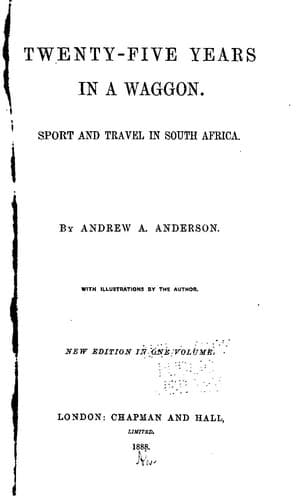
Twenty-Five Years in a Waggon in South Africa: Sport and Travel in South AfricaAnderson, Andrew A.
History
Twenty-Five Years in a Waggon in South Africa: Sport and Travel in South Africa
Anderson, Andrew A.
Africa, Southern -- Description and travel; Anderson, Andrew A. -- Travel -- Africa, Southern
The principal road from Barmen Mission Station to Ovampoland runs along
by the Omuramba river, between which and Damara the country is divided
by an immense thorn district. Beautiful and picturesque scenery is to
be found in Damaraland, where the granite hills stand out in bold and
massive peaks. The mineral wealth of this region is little-known;
copper, lead, and silver, also iron, abound in the mountains. The
natives speak the Otjiherero language. There are many mixed races
spread over the country, and great numbers of cattle, sheep, and goats
are kept by them. Several mission stations are established in the
country: Barmen, Otjimbinque, Schmelin's Hope and others. The climate
is very healthy. All the large game are found in these regions. The
Damaras hunt them with the bow and arrow, but of late years guns have
been introduced into the country. They are a stout and powerful people,
very dirty in their habits, and seldom remain long in one locality,
being pastoral, cultivating no corn, and always at war with the Berg
Damaras, being of a different tribe, using the Hottentot language.
The Rhenish Missionary Society hold most of the stations, and have been
great sufferers by these lawless tribes, being plundered, and several of
them ruined, which has destroyed the trade of the country.
[Illustrative of which, one of the missionary's goats was being
constantly milked. One Sunday evening he caught a man at it, who ran
away, and he threw a piece of wood at him; and complained to the chief,
who decided that the man was sufficiently punished by that, and the
missionary was fined a goat for breaking the Sabbath.] Many English
traders were robbed and some wounded. The mission stations were
established about 1830, but scarcely anything has been done in
civilising the people. The Namaquas live by plundering their
neighbours, the Damaras. This was the state of affairs when I first
visited that region. Since then they have been robbing the Damaras of
their cattle. Several mission stations have been destroyed. Their
store at Walfish Bay was broken open and everything stolen, and the
manager, Mr. Toerson, murdered. The Europeans in the country, numbering
about thirty, made application for assistance at Cape Town. The
governor sent a man-of-war to Walfish Bay, which returned without
landing. Since then several British subjects have been murdered, and so
things have gone on from bad to worse, and not until 1875 were any steps
taken; then a commissioner was despatched to endeavour to settle
matters, but his influence had little effect in restoring order, and
eventually he returned to Cape Town. It is of the highest importance to
the Cape Colony that Walfish Bay and the coast-line for fifty miles
north and south of it should be annexed to that colony as being the
principal outlet for the native trade of the interior. If it should
fall into foreign hands an immense injury would accrue by the taking
Public-domain text, read in full here on John Shaqi.
Reviews
Reviews
No reviews yet
Be the first to share your thoughts on this work.
Elsewhere in the archive
Join the Discussion
Join the discussion
Sign in to leave a comment or review.
Sign InorCreate an account