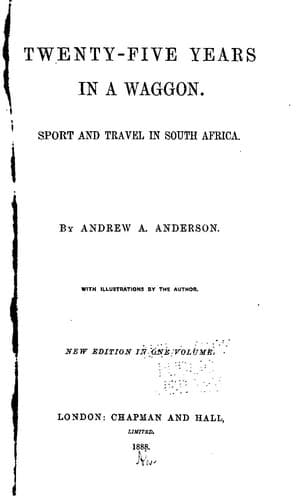
Twenty-Five Years in a Waggon in South Africa: Sport and Travel in South AfricaAnderson, Andrew A.
History
Twenty-Five Years in a Waggon in South Africa: Sport and Travel in South Africa
Anderson, Andrew A.
Africa, Southern -- Description and travel; Anderson, Andrew A. -- Travel -- Africa, Southern
away the greater portion of that trade which rightly belongs to the Cape
Colony. The chief, Kamaherero, is almost paramount in the country. The
population of the Hereros is estimated at about 40,000, and the Berg
Damaras nearly 30,000.
The importance of Walfish Bay is its having the command of all the
interior trade of Ovampoland, the Kalahara desert, and also that
extensive region at Lake N'gami, a great portion of which is brought
across the desert, therefore its importance as a British port cannot be
overrated. There is no field for emigration, as the country is too dry
for agricultural purposes, and the natives at present are too lawless
for any settled community to remain there; but as a trading-station to
collect the produce of the interior, and barter with the natives, it is
all important that it should be retained.
In the latter part of 1879 the country was in a lawless state. The
Gobabis have been robbing waggons; the Gobabis are Hottentots. They
robbed a Boer, one Van Zyl, of all he had, and he had to fly with one of
his sons, leaving his wife and another woman with seven waggons, with
horses, oxen, guns and ammunition in the hands of the Gobabis, who had
taken all except the two women. Van Zyl went to Mr. Palgrave, the
Commissioner, for help, to get his wife and waggons from the Gobabis
Hottentots, but Mr. Palgrave did not assist him, which has caused some
comment, and Mr. Palgrave started away from Walfish Bay. The Hottentots
released the two women who were prisoners, and kept everything. Nothing
has been done to bring peace to the country, as where so many petty
chiefs have separate rule in a country like this, it is impossible to
have law and order. Mr. Van Zyl was afterwards shot, and also his son
some time later.
CHAPTER FIFTEEN.
OVAMPOLAND. SOUTH CENTRAL AFRICA.
This extensive region is situated to the north of Damaraland, its
eastern boundary is the Kalahara desert, already described, and on the
north-west the Cunene river and the Portuguese settlement forms its
boundary. The high table-land extends over the whole of this region,
and is exceedingly healthy, the highest altitude being 5300 feet, as far
as I have been able to take them.
The Ovampos have large herds of cattle and goats, and cultivate corn
extensively. The people are very black, finely proportioned for
strength, and are hardworking and industrious; they speak the Otjiherero
tongue, and are very jealous of strangers.
The only river not yet described that drains Ovampoland is the Ovampo
river, which commences on the west of the Central Watershed, at an
altitude of 4200 feet, and in 19 degrees 20 minutes South latitude, 18
degrees 56 minutes East longitude, then passes north-west, through the
Great Salt vlei, it falls into the Cunene river, and thence to the
Atlantic.
Public-domain text, read in full here on John Shaqi.
Reviews
Reviews
No reviews yet
Be the first to share your thoughts on this work.
Elsewhere in the archive
Join the Discussion
Join the discussion
Sign in to leave a comment or review.
Sign InorCreate an account