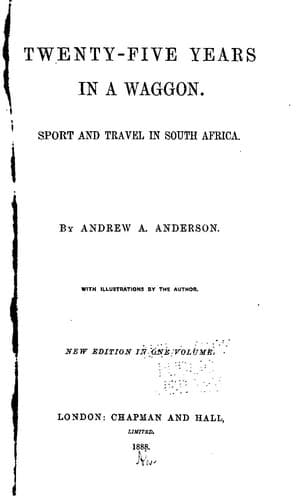
Twenty-Five Years in a Waggon in South Africa: Sport and Travel in South AfricaAnderson, Andrew A.
History
Twenty-Five Years in a Waggon in South Africa: Sport and Travel in South Africa
Anderson, Andrew A.
Africa, Southern -- Description and travel; Anderson, Andrew A. -- Travel -- Africa, Southern
One of the Boer's statements for leaving his Transvaal home may give
some idea of the feeling that pervaded these trek Boers at the time:--"I
found myself among the commandeered. On my farm nothing had as yet been
put in the ground, and as no one could be got to go as my substitute,
there was nothing for me but to go on the commando. My waggons and
cattle had also to be given up for the use of the commando. In my
absence my wife had to plough, in order to obtain sufficient food for
the year. I returned from the commando, having lost several of my
cattle on the way. I went to the field-cornet of Moi river, in whose
district I lived, with the view of obtaining compensation, but I was
informed that nothing could be done in the matter. Under the old law
compensation could be obtained for damage to what had been lent, but
there was nothing mentioned about this in the new commando laws. It
appeared the waggons and oxen were commandeered at the owner's own risk.
I was so struck with the unrighteousness of this mode of proceeding
that I felt myself compelled, with all my belongings, to join the trek
for which a party of Boers were already prepared, and with them I then
threw in my lot; and on the 2nd of March, 1877, we left the Transvaal.
Our party consisted of 600 souls, large and small, with 100 waggons,
under the command of Du Plessis, and arrived at the Crocodile river or
Limpopo, where we remained a fortnight, and then went forward into the
wilderness."
Very few ever reached their destination. They were attacked by the
natives, and had constantly to form themselves into laager to defend
themselves. Their cattle died of lung-sickness and thirst, many of them
were stolen, some lost in the bush; waggons and property had to be
abandoned; women had to inspan the waggons and drive them; to lighten
them their household goods had to be thrown from the waggons. Some few
reached Damaraland, and a few went more north into the Portuguese
possessions, where small plots of land were given to them; those in
Damaraland were taken to Cape Town from Walfish Bay, and sent back to
the Transvaal at the Cape Government expense; and this occurred during
the time the Boers had the Transvaal, and their own chosen president was
at the head of the republic.
Public-domain text, read in full here on John Shaqi.
Reviews
Reviews
No reviews yet
Be the first to share your thoughts on this work.
Elsewhere in the archive
Join the Discussion
Join the discussion
Sign in to leave a comment or review.
Sign InorCreate an account