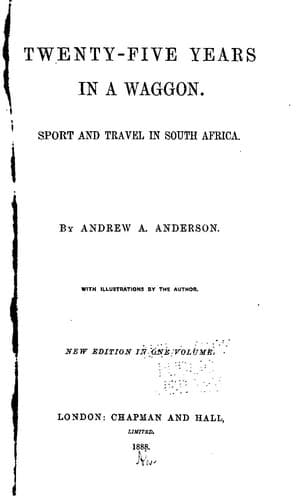
Twenty-Five Years in a Waggon in South Africa: Sport and Travel in South AfricaAnderson, Andrew A.
History
Twenty-Five Years in a Waggon in South Africa: Sport and Travel in South Africa
Anderson, Andrew A.
Africa, Southern -- Description and travel; Anderson, Andrew A. -- Travel -- Africa, Southern
In a few months after I followed them up, and saw the graves of those
who had died of fever; and a Kaffir told me one of the Boers had given
him a good gun for a small bucket of water. Chairs, tables, cooking
utensils, and other articles strewed the path through the desert; and
the bones of the dead oxen, that the vultures, wolves, and jackals had
picked clean, covered the ground where they fell--a melancholy sight;
and all this suffering was caused because these Boers found their own
republican Government unbearable to live under. And this is the best
answer to be given as to why the British Government found it imperative
to step in, and put an end to such a wretched state of affairs, which
act was accomplished on the 12th of April, 1877.
The remnant of these trek Boers were in the Portuguese territory, at the
back of Mossamedes on the west coast, perishing from starvation and
misery, when a subscription was raised at Cape Town for them, and a
ship-load of supplies and a man-of-war were sent down. They tried to
land some hundreds of miles up the coast beyond Walfish Bay, so as to be
nearer to the Boers, but were prevented by the surf; they returned, and
the supplies were sent up with great difficulty, and many of the Boers
came down, as stated, and went back by sea.
CHAPTER EIGHTEEN.
THE PHYSICAL GEOGRAPHY OF THE TRANSVAAL, AND OTHER SUBJECTS, CONTINUED.
The altitude of the Transvaal above sea-level is one of its most
important features in connection with its climate and vegetation; there
is no portion below 2890 feet, except at the northern extremity along
the Limpopo river, where the elevation is lowered on that river to 1560
feet. The other portions of the republic average 4000 feet between the
mountain ranges that traverse the country. In the north-east division,
north of the Olifants river, the Zoutpansberg range, the Tweedeberg, the
Derd mountains, the latter being within a few miles on the south side of
the Limpopo river, with the Matin hills, near which the Tave river
flows, vary considerably in altitude from 3700 to 4500, mostly of
sandstone formation. The eastern portion through which the Pafure river
flows is called Basoetla, occupied by the Mantatees, Knobnoses, and
other tribes, in large and numerous kraals along the streams; Albasini's
town being situated on the south side of Zoutpansberg.
The country is rich in corn-land and fine grasses, splendid forests of
timber, of which the famous baobab tree is very common and of immense
size, the bark of which is used for making sacks, blankets, and other
useful articles; cobalt, iron, copper, and lead, are found in great
quantities, and also gold in the more southern portion.
Public-domain text, read in full here on John Shaqi.
Reviews
Reviews
No reviews yet
Be the first to share your thoughts on this work.
Elsewhere in the archive
Join the Discussion
Join the discussion
Sign in to leave a comment or review.
Sign InorCreate an account