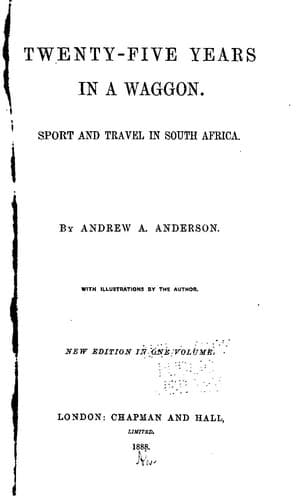
Twenty-Five Years in a Waggon in South Africa: Sport and Travel in South AfricaAnderson, Andrew A.
History
Twenty-Five Years in a Waggon in South Africa: Sport and Travel in South Africa
Anderson, Andrew A.
Africa, Southern -- Description and travel; Anderson, Andrew A. -- Travel -- Africa, Southern
Forty miles to the east is Pretoria, the capital of the republic and
seat of Government. It is pleasantly situated between low ranges of
metamorphic hills that run east and west, and is south of the
Magalisberg mountains seven miles. The city is built on an open plain,
that gradually slopes towards the north, supplied with beautiful
fountains that rise a few miles on the south of the town, the water
falling into the Apes river. An isolated hill, about three miles on the
east of the town, is a conspicuous object in the landscape. The streets
run parallel; the market-square is open, with the Dutch church in the
centre; there are several good hotels and a cathedral; Bishop Bousefield
lives in a snug house, with very fine blue gum trees in front. Many
large stores were erected during the British occupation; but at the
retrocession the greater number were deserted, and a general exodus of
the English took place, for it was impossible to live under the new
state of affairs. The town in 1875 was not one-fourth the size it was
when the Transvaal was returned to the Boers in 1881. Mr. Burgers was
then president, and he laboured hard to improve the country; but the
people were not to be moved, and no advance in civilising them could be
made. There was no money in the country, except a little English gold,
everything was by barter until 1865, when paper money was issued, called
bluebacks, to the extent of 10,000 pounds, and from time to time fresh
issues were made to meet the expenses of the State. They varied in
value, viz. in 2 shillings 6 pence, and 1 pound 5 shillings notes, but
commercially the 1 pound 5 shilling notes were only worth two to three
shillings. I had many of them, which I took at that price, and disposed
of them for the same; but if you had to pay the Government tax the full
price was allowed, for they could not refuse their own notes.
The country is open and free from any extensive wood, and the climate is
suitable to produce every kind of vegetation. In the spring of the year
the thick rose-hedges which divide the gardens give a very pleasing
appearance to the town, when they are in full bloom. The extensive
barracks and fortifications erected by the British Government on the
south of the town, at a cost of over 100,000 pounds, have been made a
present to the Boer Government for their disloyalty to British rule.
Public-domain text, read in full here on John Shaqi.
Reviews
Reviews
No reviews yet
Be the first to share your thoughts on this work.
Elsewhere in the archive
Join the Discussion
Join the discussion
Sign in to leave a comment or review.
Sign InorCreate an account