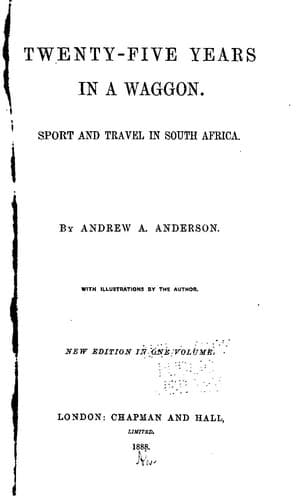
Twenty-Five Years in a Waggon in South Africa: Sport and Travel in South AfricaAnderson, Andrew A.
History
Twenty-Five Years in a Waggon in South Africa: Sport and Travel in South Africa
Anderson, Andrew A.
Africa, Southern -- Description and travel; Anderson, Andrew A. -- Travel -- Africa, Southern
As we advanced along the bank we became aware that large game occupied
the other side of the river. The dense forest prevented our seeing
them, but there was no mistaking the sounds. Elephants were near, by
the breaking of branches and the constant rumbling sound of their
bowels. The river was too deep and dangerous to cross, therefore I had
no choice left but to remain quiet and concealed in the shadow of the
beautiful trees, the branches of which overhung the river. We knew they
were approaching the river to drink. After waiting some twenty minutes,
one by one they pushed themselves through the undergrowth that lined the
steep bank, and made for the water, standing in a row close together,
sucking up with their trunks the water into their immense throats, an
operation that looks ridiculous, a sight seldom to be seen in daylight.
To have fired upon them would have been cruel, as there was no
possibility of getting their tusks even if we had killed them; we
therefore watched with intense interest this interesting sight.
After satisfying their thirst, they walked into the river until they
were half submerged, throwing water over their backs, and flapping their
immense ears against their sides, making a peculiar noise, evidently
enjoying the bath immensely, pawing the water with their huge legs; and
then returned to the forest, to browse on the young and tender branches
of their favourite trees. There were thirty-seven full-grown, and
eleven young ones of various sizes. It was with difficulty I could
restrain my boys from giving them a shot. To see elephants, the largest
of all animals, in their native wilds roaming undisturbed, and note
their habits and actions, is most interesting.
These gigantic animals care very little for crocodiles or hippopotami;
but the rhinoceros often kills them. Their long legs, being six feet in
length, and nearly three feet round, are very formidable when used in
their own defence, either on land or water, without the aid of their
five feet of tusks. At the present time these splendid animals are
never seen in these parts, where formerly they were so plentiful. Mr.
John Viljoen, the Boer who came north after the Bloomplaats fight in
1848, thirty-seven years ago, and settled in Marico, told me that the
whole of that district swarmed with elephants and every other kind of
large game, as also in the neighbourhood of Rustenburg, Pretoria, and
other localities more south; now they are seldom seen south of the
Limpopo, except in the country to the east, under the chief Umzela.
In the trees on the opposite shore, and in the forest behind us, large
grey monkeys, with black faces, were busy watching us. There appeared
to be hundreds, and as they swung from branch to branch, with the young
ones following their mothers, they made the forest look lively. They
travel on the tops of the trees faster than you can run below.
Public-domain text, read in full here on John Shaqi.
Reviews
Reviews
No reviews yet
Be the first to share your thoughts on this work.
Elsewhere in the archive
Join the Discussion
Join the discussion
Sign in to leave a comment or review.
Sign InorCreate an account