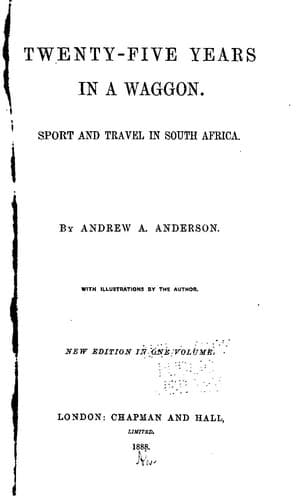
Twenty-Five Years in a Waggon in South Africa: Sport and Travel in South AfricaAnderson, Andrew A.
History
Twenty-Five Years in a Waggon in South Africa: Sport and Travel in South Africa
Anderson, Andrew A.
Africa, Southern -- Description and travel; Anderson, Andrew A. -- Travel -- Africa, Southern
To the south of Birue is the district of Quitive, a portion of Sofala
that joins up to the Sabia, on the south by Umselayon region. This
district is supposed to be the kingdom of the Queen of Sheba. Manica is
the principal kraal, near which are several ancient ruins, and the
remains of a tower a few miles to the north-west of Manica. It stands
on high ground, 4100 feet above sea-level, which descends to the east,
and not far from the ruins is a large sheet of water, also several
plains on the south of Manica. The population is a mixed race, composed
of Umgovis, who are part Zulus, Mandowas, Basigas, Batagas, Mashonas,
and others, who are under the chief Umzela. There are extensive open
grass-lands, and the low-lying country is healthy during five months of
the winter, when there is no fear of taking the fever. Thirty miles
south of Manica the land rises to 4458 feet.
To the east of this district is the Sofala region, in which the
Portuguese town and port of Sofala are situated. The town is but a poor
place, as all the Portuguese towns are on this coast; but they command
all the trade of the up districts, which is considerable in ivory,
skins, a few ostrich feathers, and other products of the country. It is
situated in 20 degrees 10 minutes South latitude, 34 degrees 30 minutes
East longitude. The country at the back of the town is hilly, occupied
by the Mandowa tribe, and is more healthy. The river Bozi flows through
it to the sea, well-wooded with fine timber and bush. Elephants,
rhinoceros, and large game abound. Rice, cotton, spices of all kinds,
oranges, lemons, citrons, bananas, figs, and wild fruit. I was told
that Umzela, the chief who occupies the country south, claims as
paramount chief all those districts in the north, down to the Mandanda
region; but his claim is something similar to that of the Portuguese,
who lay claim to all South Africa to the Atlantic Ocean, from Sofala.
He must be content to put up with such regions as he now has power to
govern; and those countries north of Birue are independent, except such
portions along the coast and up the Zambese as the Portuguese have the
power to rule, which is not much beyond the guns at their so-called
forts. With respect to any extensive or strong stone remains of ancient
cities, supposed to have belonged to the love-sick Queen, there are
none, beyond those that have been erected without mortar. If this
district formed part of her kingdom where she resided, her palace must
have been small, and of no account. If substantial buildings had been
erected, they would surely be there now, as the natives with the means
at their disposal could not have destroyed them; but what is so
remarkable is that no relics have been found of any kind, no rubbish
left where they may have stood. The only one I discovered was in a
stream of the Sabia, where the copper beads were found. It was an oval
piece of copper, the size of a sixpence, and as thick, with much defaced
Public-domain text, read in full here on John Shaqi.
Reviews
Reviews
No reviews yet
Be the first to share your thoughts on this work.
Elsewhere in the archive
Join the Discussion
Join the discussion
Sign in to leave a comment or review.
Sign InorCreate an account