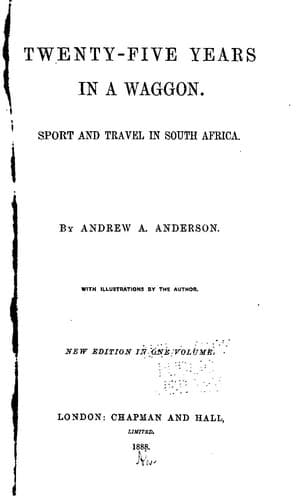
Twenty-Five Years in a Waggon in South Africa: Sport and Travel in South AfricaAnderson, Andrew A.
History
Twenty-Five Years in a Waggon in South Africa: Sport and Travel in South Africa
Anderson, Andrew A.
Africa, Southern -- Description and travel; Anderson, Andrew A. -- Travel -- Africa, Southern
marks on both sides that cannot be made out, being so much worn. To
pronounce it a coin would be premature. When the country is properly
prospected, there may be found sufficient evidence to settle this
long-disputed question; but if extensive ruins existed, the natives
would know, and it would soon have reached the ears of travellers that
have passed through that country. There must be some foundation for
these ancient traditional reports. The country shows that in remote
times gold in large quantities has been extracted from the earth, and if
it is so easily found in the rivers, why should not nuggets have been
found lying on the surface, which first drew the attention of the
ancients to look for it. The name of the river flowing through this
region, the "Sabia," may have been changed by time from "Sheba," the
same as "Sofala" for "S'Ophir." There is also a ruin called Piza, and
another Manica, two names foreign to the other names of the country; and
the region of Monomotapa may have received its name from some early
inhabitants, descendants of the people under this renowned queen. At
present nothing is definite on this point, and the magnificence of her
palaces have been, much overrated in ancient history. If this was the
real Ophir of Solomon, the Arabs along the coast and at Sofala believe
this to be the true Ophir, Umzela was the great chief of all that part
of the country known as the Birue, Quitive, Sofala, and Mandanda
regions. His chief kraal, Utshani, is situated in 20 degrees 27 minutes
South latitude, 32 degrees 28 minutes East longitude, between lofty
hills, the altitude being 3180 feet by aneroid barometer, and it is
situated on the upper source of the Buzi river, which flows in a
north-east direction and enters the Indian Ocean on the north of the
town and port of Sofala. The country is very fertile, and the banks of
the Sabia on the west of the town, through which that river meanders in
a south direction, is flanked by high and picturesque hills, and clothed
in all the beauty of tropical vegetation. Mahogany, ebony, untanto,
palm, umchani, maparri, umsimbili, bananas, assagaai or lance wood,
barrie, boschlemon, wild almond, kajaten (a fine black wood), knopjes
doorn, wild olive, saffraan, fig, cabbage tree, makwakwe (the strychnine
of the country), vitboom (quinine), india-rubber, and a host of other
sorts that would fill a page if named, all most valuable for various
purposes. Large flocks of sheep and goats and herds of cattle are
reared. There is also the large game, such as elephants, rhinoceros,
giraffes, buffaloes, koodoos, and other large antelopes, lions, tigers,
wolves, jackals, tiger-cats in plenty, beside the various earth-animals,
ant-bears, porcupines, armadillos, and many others. Umzela's territory
is called Umselayon, which embraces all those districts above described.
The mountains which completely encircle the chief's kraal are very
picturesque and peculiar in their form, making the Sinika river a
Public-domain text, read in full here on John Shaqi.
Reviews
Reviews
No reviews yet
Be the first to share your thoughts on this work.
Elsewhere in the archive
Join the Discussion
Join the discussion
Sign in to leave a comment or review.
Sign InorCreate an account