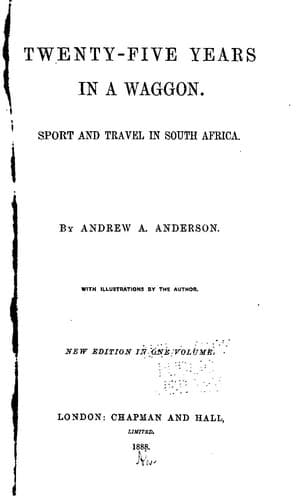
Twenty-Five Years in a Waggon in South Africa: Sport and Travel in South AfricaAnderson, Andrew A.
History
Twenty-Five Years in a Waggon in South Africa: Sport and Travel in South Africa
Anderson, Andrew A.
Africa, Southern -- Description and travel; Anderson, Andrew A. -- Travel -- Africa, Southern
Referring again to the land of Ophir, there are no black races in any
other part of Africa that allow a woman to rule over them; but in the
immediate neighbourhood of Sofala there are three queens, viz. Queen
Mafussi over Inhoaxe, adjoining Umzela's territory, and immediately on
the south of her are the two Queens Majaji and Mescharoon. May not this
be one identification, that it was right that woman should be a ruler as
well as man, handed down from the Queen of Sheba's time? Also a large
portion of Madagascar is ruled over by an Arab race that must have
settled there a very long time ago. Their language is Arabic, and
queens of that island have and do now rule the greater portion of it.
CHAPTER TWENTY FIVE.
THE PORTUGUESE POSSESSIONS ON THE EAST COAST, WITHIN SOUTH CENTRAL
AFRICA.
The earliest records we have of this coast-line is from the Portuguese,
who first sailed round the Cape to the north, as far as the Mozambique
coast, in 1497, under Vasco de Gama. In 1508 they visited the coast
again and conquered Sofala, and soon after Quilimane, Inhambane, and
Delagoa Bay, where they built a fort at Lorenzo Marques in the inner
harbour, and took possession of the coast northwards, including the
mouth of the Zambese and both banks of that river beyond Tette, where
they formed a town, claiming the country far in, up the river and along
the coast, but at the present time they have no jurisdiction over it,
beyond a few miles of the coast, the natives not allowing any
interference with their rights beyond the reach of their guns at the
forts.
Up to 1875 the Portuguese only held the northern portion of Delagoa Bay,
down as far south as the 26 degrees South latitude, and half of the
island of Inyack; the English Government disputing their claim to any
territory south of the 26 degrees, and the southern portion of Inyack
was held by the British Government. Much correspondence passed between
the two Governments, when it was referred to arbitration, and Marshal
MacMahon, then President of the French Republic, decided in July, 1875,
that the Portuguese had a right to the country down to 26 degrees 30
minutes South latitude, which included the whole of the bay and island
of Inyack--to the exclusion of British interests. The boundary then
laid down as the southern limit of Portugal should follow that latitude
up to the Lobombo mountain, which borders on Swaziland, an independent
chief.
Public-domain text, read in full here on John Shaqi.
Reviews
Reviews
No reviews yet
Be the first to share your thoughts on this work.
Elsewhere in the archive
Join the Discussion
Join the discussion
Sign in to leave a comment or review.
Sign InorCreate an account