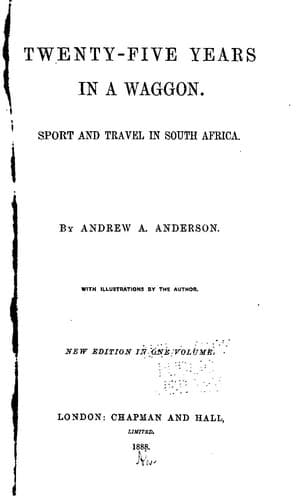
Twenty-Five Years in a Waggon in South Africa: Sport and Travel in South AfricaAnderson, Andrew A.
History
Twenty-Five Years in a Waggon in South Africa: Sport and Travel in South Africa
Anderson, Andrew A.
Africa, Southern -- Description and travel; Anderson, Andrew A. -- Travel -- Africa, Southern
Following the mountain north to the middle of the lower part of the
Comatie river, where it flows through that mountain, from thence in a
north-east direction to Pokionies Kap, on the north side of the Olifant
river, where it passes through the mountain north-west by north, to the
nearest point of the Stricundo mountain, on the Umzim Voobo river, then
in a straight line north to the junction of the Pafarie river with the
Limpopo. All on the west of this line is the Transvaal boundary. This
is the boundary on paper and maps, but the Portuguese have no more
jurisdiction over the country north of 25 degrees between the sea and
the Transvaal boundary, than they have over Umzela's territory, with the
exception of a small portion along the coast to the Zambese river, and
up that river to Tette. The Barpeda tribes, east of the Transvaal, are
divided into many classes, ruled over by independent chiefs.
The country at the back of Delagoa Bay is a flat unhealthy country for
forty miles inland, when it begins to rise, until the summit of the
Lobombo mountain is reached. The river Lorenzo Marques, which enters
the inner harbour at Delagoa Bay, is navigable for small craft for forty
miles up. The region to the north of that harbour, through which the
lower portion of the river Limpopo passes, is a low flat country, full
of bush, and most unhealthy. The tsetse-fly swarms. Large game is
plentiful over all this region. The southern portion is called Gasa;
the northern, Umhlenga--already described. The entrance of the Limpopo
river is in 25 degrees 17 minutes South latitude, and about three miles
broad, which it continues to be up to the junction of the Olifant river,
gradually narrowing towards the north. It is full of hippopotami and
alligators that grow to an enormous size, and several kinds of fish.
Lorenzo Marques is the capital of the Portuguese possessions in East
Africa; for some distance along the coast it is a dirty unhealthy place.
The fort mounts a few old guns, and is the governor's residence.
Several stores are kept by Portuguese natives and one or two English.
The inner harbour, upon which the town is built on the north bank, is
picturesque. Tropical trees of many varieties grow: cocoa-nuts, palms,
bananas, lemons, oranges, beside vegetables; but the inhabitants are a
lazy set of people, and the town or country will never improve under its
present Government.
Public-domain text, read in full here on John Shaqi.
Reviews
Reviews
No reviews yet
Be the first to share your thoughts on this work.
Elsewhere in the archive
Join the Discussion
Join the discussion
Sign in to leave a comment or review.
Sign InorCreate an account