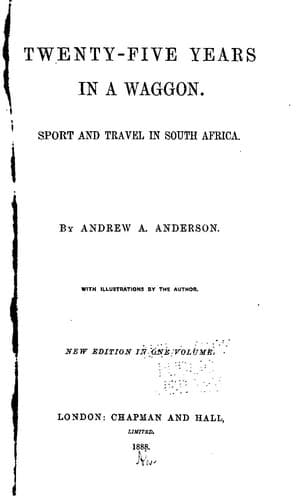
Twenty-Five Years in a Waggon in South Africa: Sport and Travel in South AfricaAnderson, Andrew A.
History
Twenty-Five Years in a Waggon in South Africa: Sport and Travel in South Africa
Anderson, Andrew A.
Africa, Southern -- Description and travel; Anderson, Andrew A. -- Travel -- Africa, Southern
Of the natives there are the Hottentot, whose pure breed is nearly
extinct; a few are now living on the banks of St. John's river.
Korannas, who are closely allied to the Hottentot, and are found more to
the north on the Orange river, as also the Bushman. Griquas, a bastard
tribe, descendants of the Dutch and Hottentot women, who have their
separate captains, and live much after the Boer in habits and customs.
In the Cape Town district are many Malay from India; in fact I may say
one-fourth of the population is made up of them. Those races that may
be termed Kaffirs are the Gaika, Gonebi, Amakosa, Slambie (who occupy
lands in British Kaffraria), Amagaleka, Amatembu in the eastern part of
Queen's Town, and the country to the east of this division on to Natal
is Kaffirland proper, known under the name Tambookies.
Railroads have been extensively increased of late years, running through
the country to all parts. One direct from Cape Town to Port Elizabeth,
another direct to Kimberley, Worcester, Graham's Town, King William and
Queen's Town, and many other parts.
The public transport roads are in most cases good, but many that wind
over the steep mountain passes are very bad, and trying to oxen and
mules when they have heavy loads.
Griqualand West forms a portion of the Cape Colony, and is situated on
the north side of the Orange river, and as it has been fully described
in the first part of this work, in consequence of the greater portion of
it being included in South Central Africa, I have merely to state that
Kimberley, Bulfontein, De Beers and De Toitspan, the four large mines,
now form one considerable town, and may be considered the richest of any
in the colony, with a population that is not living in a sleepy hollow,
as the rest of the colony is, but showing some vitality and energy,
which has in a great measure saved the colony from ruin.
The district of Cape Town is very pretty and picturesque, well planted
with firs and other trees. The town is well supplied with fruit of
almost every description and vegetables. Abundance of fish are caught
in the bay.
The climate is mild and healthy; the rainy season commences in the
autumn, about May, and lasts until August. In the summer months it is
rare to have a storm.
Wild animals are becoming very scarce; a few of the large game such as
the elephant and buffalo are preserved in the Addo, Kowie, and
Zitzchkamma forests, and may be occasionally seen going down in troops
of thirty and forty to the sea to have a bath. A few wild beasts;
blesbok and many springbok may now be seen on the plains, and also the
ostrich.
Tigers and tiger-cats are yet plentiful in the kloofs of the mountain
ranges that extend so far through the colony. A few sea-cow, I believe,
are still to be seen in the rivers on the eastern border, beyond East
London.
Public-domain text, read in full here on John Shaqi.
Reviews
Reviews
No reviews yet
Be the first to share your thoughts on this work.
Elsewhere in the archive
Join the Discussion
Join the discussion
Sign in to leave a comment or review.
Sign InorCreate an account