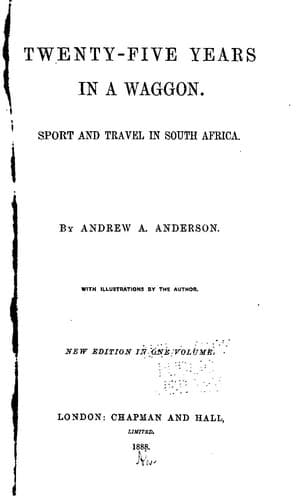
Twenty-Five Years in a Waggon in South Africa: Sport and Travel in South AfricaAnderson, Andrew A.
History
Twenty-Five Years in a Waggon in South Africa: Sport and Travel in South Africa
Anderson, Andrew A.
Africa, Southern -- Description and travel; Anderson, Andrew A. -- Travel -- Africa, Southern
Between the eastern division of the Cape Colony, that is Kaffraria
proper, and the upper part of the Caledon river, is Basutoland, an
extensive region that joins up to Natal or Drakensberg mountain as its
eastern boundary, the north by the Caledon river and the Orange Free
State, as also a portion of its western boundary. The country is very
mountainous, with deep and thickly wooded kloofs, making the scenery
very lovely. Some of the hills on the Drakensberg side are 9500 feet
above sea-level. The Basutos are a branch of the Bechuana family, of
the Barolong tribe, the same family as Montsioa, who left Basutoland
when young, and occupied the country he now holds on the Molapo river.
The small district of Thaba Nchu belonged to these people, which was
separated from Basutoland by the Free State, and in fact that state
surrounded it; and in consequence of a difference between the two
chiefs, Samuel and Sepinare Moroka (the latter being killed), President
Brand went with a force of Free State burghers and took possession of
the town and territory of Thaba Nchu, and annexed it to that state.
Samuel was the son of the old chief Moroka, the other his nephew. When
Moroka died in 1880, the people were divided as to who should be the
chief. There is no doubt the son had the greatest claim; he was an
educated Kaffir, having spent several years at St. Augustine's College,
Canterbury, and was in every respect a gentleman in behaviour. He is
now a wanderer amongst his tribe.
Thaba Nchu, in 1863, was the largest native town in British South
Africa; the population then was about 9000, with mission houses and
church schools.
Public-domain text, read in full here on John Shaqi.
Reviews
Reviews
No reviews yet
Be the first to share your thoughts on this work.
Elsewhere in the archive
Join the Discussion
Join the discussion
Sign in to leave a comment or review.
Sign InorCreate an account