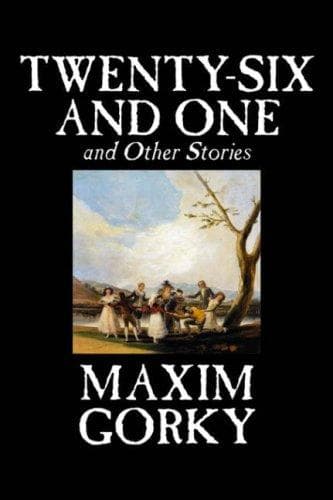
Twenty-six and One, and Other StoriesGorky, Maksim
General
Twenty-six and One, and Other Stories
Gorky, Maksim
Russia -- Social life and customs -- Fiction; Short stories, Russian -- Translations into English
"A leg, a chest, in everything there must be firmness. And then,
again, the man must be dressed according to style. . . . As the
beauty of things requires it. I, for instance, I am loved by women.
I don't call them, I don't lure them, they come to me of themselves."
He seated himself on a bag of flour and told us how the women loved
him and how he handled them boldly. Then he went away, and when the
door closed behind him with a creak, we were silent for a long time,
thinking of him and of his stories. And then suddenly we all began
to speak, and it became clear at once that he pleased every one of
us. Such a kind and plain fellow. He came, sat awhile and talked.
Nobody came to us before, nobody ever spoke to us like this; so
friendly. . . . And we all spoke of him and of his future successes
with the embroidery girls, who either passed us by, closing their
lips insultingly, when they met us in the yard, or went straight on
as if we had not been in their way at all. And we always admired
them, meeting them in the yard, or when they went past our
windows--in winter dressed in some particular hats and in fur coats,
in summer in hats with flowers, with colored parasols in their hands.
But thereafter among ourselves, we spoke of these girls so that had
they heard it, they would have gone mad for shame and insult.
"However, see that he doesn't spoil Tanushka, too!" said the baker,
suddenly, with anxiety.
We all became silent, dumb-founded by these words. We had somehow
forgotten Tanya; it looked as though the soldier's massive, handsome
figure prevented us from seeing her. Then began a noisy dispute.
Some said that Tanya would not submit herself to this, others argued
that she would not hold out against the soldier; still others said
that they would break the soldier's bones in case he should annoy
Tanya, and finally all decided to look after the soldier and Tanya,
and to warn the girl to be on guard against him. . . . This put an
end to the dispute.
About a month went by. The soldier baked white bread, walked around
with the embroidery girls, came quite often to our workshop, but
never told us of his success with the girls; he only twisted his
moustache and licked his lips with relish.
Tanya came every morning for the biscuits and, as always, was
cheerful, amiable, kind to us. We attempted to start a conversation
with her about the soldier, but she called him a "goggle-eyed calf,"
and other funny names, and this calmed us. We were proud of our
little girl, seeing that the embroidery girls were making love to the
soldier. Tanya's relation toward him somehow uplifted all of us, and
we, as if guided by her relation, began to regard the soldier with
contempt. And we began to love Tanya still more, and, meet her in
the morning more cheerfully and kind-heartedly.
Public-domain text, read in full here on John Shaqi.
Reviews
Reviews
No reviews yet
Be the first to share your thoughts on this work.
Join the Discussion
Join the discussion
Sign in to leave a comment or review.
Sign InorCreate an account