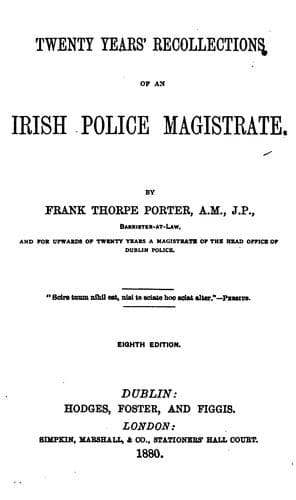
Twenty Years' Recollections of an Irish Police MagistratePorter, Frank Thorpe
History
Twenty Years' Recollections of an Irish Police Magistrate
Porter, Frank Thorpe
Crime -- Ireland; Criminals -- Ireland; Ireland -- Social life and customs; Porter, Frank Thorpe, 1801-1882
The Count remarked the expression, and observed--"Why, Vaughan, it would
appear that you have met the captain before you took service with us."
"We have met," said the soldier; "he knows when and where; he will tell
you what he knows, but he does not know all. Ye are two gentlemen on
whose honor I can rely, and I shall tell you on one condition."
"Excuse me," said the Count, "my curiosity is not so intense as to make
me desirous of a confidence disagreeable either to Captain Vesey or to
you. You have been a good soldier, in every respect, since you entered
the regiment. I have known you only in that capacity. I have no wish to
be informed on any previous transaction."
"And I pledge my hand and word," said Vesey, "that I shall never allude
to you except as the man to whose humane exertions I am indebted for my
life."
He extended his hand to the soldier, who respectfully pressed it between
his own, saying--"Let it be so, I am fully satisfied." He saluted the
Count and departed.
In about two months after an exchange of prisoners was effected. The
Count and Vesey parted with mutual regret and assurances of lasting
friendship. A few minutes before they parted, the Count mentioned that
he had procured for Vaughan the grade of sergeant. Vaughan asked and was
granted an opportunity of bidding the Captain a respectful farewell. The
military operations of the English were for some time extensive and
diversified; and during eleven years Vesey did not revisit Ireland. He
had been in India and in America; and he again became a prisoner to the
French in 1756, when the Duc de Richlieu captured Minorca. There he
again met with the Count de St. Woostan. Their friendship was renewed,
and Vesey, who had attained to the rank of colonel, obtained permission,
upon parole, to visit Paris, whither the Count was proceeding with
despatches. He casually enquired for Vaughan, and was informed by the
Count that soon after their parting at Lille, Vaughan's brother,
Sylvester, had arrived from Ireland, and joined the regiment. He was
killed at the battle of Raucoux, where Martin was severely wounded, and
had consequently become an inmate of the _Hotel des Invalides_. There
Colonel Vesey again saw the man, whose escape from an ignominious death
had often occasioned perplexing conjectures to his prosecutor. The old
sergeant evinced great pleasure at the Colonel's visit, attended him
through the establishment, and having conducted him into one of the
arbors, which the veterans of the Invalides have, from the very
commencement of the institution, cultivated with peculiar care and
taste, he offered the Colonel a seat under an agreeable shade, and
requested him to listen to a narration of the escape which had been
effected from Old Kilmainham. "I need not now, sir," he added, "ask any
condition from you, for the man who arranged the affair is dead. No one
can now be injured by the disclosure. I have bitterly mourned the
Public-domain text, read in full here on John Shaqi.
Reviews
Reviews
No reviews yet
Be the first to share your thoughts on this work.
Join the Discussion
Join the discussion
Sign in to leave a comment or review.
Sign InorCreate an account